Written By: Irene Maneesh Matthew
Edited By: Mannat Malhan
Designed By: Andria Sahar
Published By: Ayman Khan
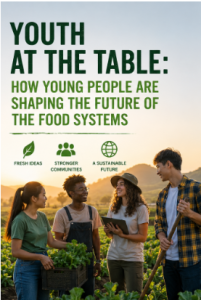
Food is more than just what we eat. It is deeply connected to our health, environment, economy and culture. Today, food systems around the world face growing challenges, including climate change, food insecurity, biodiversity loss and increasing population demands. As these issues become more urgent, one group is emerging as a powerful force for change: young people. Far from being passive consumers, today’s youth are becoming innovators, entrepreneurs, advocates and decision-makers who are helping shape the future of sustainable food systems.
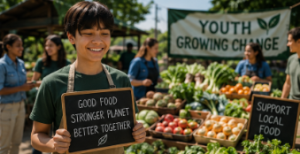
Young people bring fresh perspectives, creativity and technological skills to agriculture and food production. With access to digital tools, social media and innovative technologies, many young entrepreneurs are transforming traditional farming into smarter and more sustainable practices. Precision agriculture, hydroponics, urban farming and climate-smart agriculture are just a few examples of innovations that young people are embracing to increase productivity while reducing environmental impacts. These approaches not only improve food production but also make agriculture more attractive to future generations.
Youth are also leading efforts to promote healthy and sustainable food choices. Through online campaigns, school initiatives and community organizations, they are raising awareness about food waste, nutriti 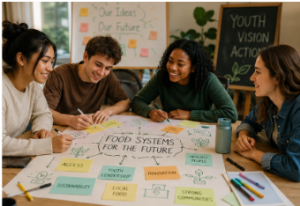 on and environmentally friendly diets. Many young activists encourage consumers to support local farmers, reduce plastic packaging and choose sustainably produced food. Their influence on social media has helped spread important messages about responsible consumption and the importance of protecting natural resources.
Another significant contribution of youth is their role in climate action. Agriculture both contributes to and is affected by climate change, making sustainable food systems essential for environmental protection. Young climate advocates have consistently called on governments and
businesses to adopt policies that reduce greenhouse gas emissions, conserve biodiversity and strengthen food security. Their participation in international forums has highlighted the need for food systems that are resilient, equitable and environmentally sustainable. By demanding accountability from leaders, young people are ensuring that food policies reflect the needs of future generations.
In addition to advocacy, many young people are creating businesses that address food system challenges. Start-ups focused on sustainable farming, food processing, alternative proteins, digital marketplaces and food redistribution are helping reduce waste while creating employment opportunities. These enterprises demonstrate that innovation can improve both economic development and environmental sustainability. Youth entrepreneurship also encourages local food production, strengthens rural economies and increases access to nutritious food.
However, despite their potential, many young people still face barriers to participating fully in food systems. Limited access to land, financing education, technology and agricultural training often prevents them from entering the sector. In many regions farming is viewed as an unattractive career due to low incomes and limited opportunities. Addressing these challenges require supportive government policies, investment in education and digital infrastructure, mentorship programs and greater access to financial resources. Empowering youth means giving them the tools and opportunities to lead meaningful change.
International organizations increasingly recognize the importance of youth engagement in transforming food systems. The Food and Agriculture Organization (FAO), the World Food Forum and the United Nations have all emphasized that young people should not simply be beneficiaries of food policies; instead, they should actively participate in designing and implementing them. Their lived experiences, innovative ideas and long-term stake in the future make them essential partners in achieving sustainable development goals, particularly Zero Hunger (SDG 2).
Creating inclusive food systems requires giving young people a genuine seat at the decision-making table. Governments, educational institutions, businesses and civil society organizations must invest in youth leadership and create space where their voices are heard. Collaboration across generations can produce more resilient and innovative solutions to today’s food challenges.
The future of food systems depends on the energy, creativity and commitment of young people. By embracing innovation, promoting sustainability, advocating for climate action and building resilient food businesses, youth are already driving meaningful change around the world. Supporting their participation is not simply an investment in the next generation; it is an investment in a healthier, more sustainable and food-secure future for everyone.
References:
Food and Agriculture Organization (FAO). (2025). The Status of Youth in Agrifood Systems, https://www.fao.org/family-farming/detail/en/c/1740010/?__cf_chl_f_tk=gE5VJUpe5LDJdPs.kSrQupoCchYk.wmvtaJM_y7rPn0-1783034177-1.0.1.1-kwWYPYbe0LW7aQhc969MjgpFH5bjqIEBJscZ1BDg5AA, Accessed July 2nd, 2026.
Glover, D., & Sumberg, J. (2020). Youth and Food Systems Transformation. Frontiers in Sustainable Food Systems, 4, 101, https://www.frontiersin.org/journals/sustainable-food-systems/articles/10.3389/fsufs.2020.00101/full, Accessed July 2nd, 2026.
Food and Agriculture Organization (FAO). (2021). Engaging Youth to Secure the Sustainable Future of Food, https://www.fao.org/newsroom/detail/Engaging-youth-to-secure-the-sustainable-future-of-food/en, Accessed July 2nd, 2026.
United Nations Food Systems Summit. (2021). Young People Show Leadership in Shaping Outcomes of the UN Food Systems Summit, https://www.un.org/en/food-systems-summit/news/young-people-show-leadership-shaping-outcomes-un-food-systems-summit, Accessed July 2nd, 2026.