Written by: Mannat Malhan
Edited by: Soham Parmer
Designed by: Yaashi Mulchandani
Published by: Marwa Damanhoury
Soups of the World
Every country has its comfort foods, and soup seems to be one of the few that manages to show up almost everywhere, no matter how differently it looks. The soups in this blog aren’t simply traditional recipes that have been passed down unchanged, but rather involve histories with colonialism, religion, agriculture, regional differences, and ingredients moving from one part of the world to another. Some have fairly well-documented beginnings, while others have been around long enough that nobody can point and say what the first bowl looked like. Where did these soups actually come from, and how did they become the dishes people know today?
1. Pho – Vietnam
Pho is usually associated with Vietnam as a whole, but its history begins much more specifically in the Red River Delta of northern Vietnam, particularly around Nam Định and Hanoi. Most accounts place its development in the late nineteenth or early twentieth century, during French colonial rule. Nam Định had become an important industrial centre, and in 1898 a large French textile factory opened there, bringing thousands of workers into the area and increasing demand for beef. Cattle had been traditionally valued in Vietnamese farming as working animals, especially in rice cultivation. Beef was therefore not a major everyday food for many Vietnamese communities. French demand meant that considerably more cattle were being slaughtered, leaving behind bones and other parts that could be used to make broth. Local cooks began simmering the bones with spices like star anise, cinnamon, fennel seeds, and cardamom, alongside serving the resulting broth with rice noodles and beef.
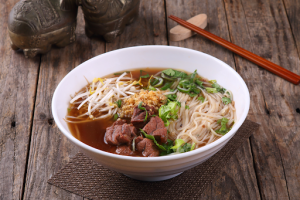
Vietnamese cooks already had traditions of noodle soups, while Chinese communities in Vietnam had their own noodle dishes and culinary influences. Pho seems to have developed from this existing food culture while incorporating the newly available beef and French eating habits. The exact amount of French influence remains debated, particularly the popular theory that the name pho came from the French pot-au-feu. There is no conclusive evidence proving that explanation.
By the early twentieth century, pho had moved beyond Nam Định. The construction of Long Biên Bridge in Hanoi in 1899 brought large numbers of workers from the surrounding region into the capital, helping spread the dish. Vendors began selling pho from street stalls and even carrying the ingredients through the streets on shoulder poles. By 1919, a French observer had recorded Vietnamese vendors selling beef soup with flat rice noodles in Hanoi, providing some of the earliest written evidence of pho as a recognizable Vietnamese dish.
Pho remained primarily a northern dish for several decades. By around 1950, it had reached Saigon, and the 1954 Geneva Accords caused another major change when large numbers of northern Vietnamese moved south. Pho travelled with them, and southern cooks adapted it to local tastes. Southern pho generally developed a sweeter broth and was served with a larger selection of bean sprouts, herbs, sauces, and other garnishes, while northern pho retained a simpler style. The modern popularity of pho is therefore the result of several stages: a northern Vietnamese origin, changes brought by French colonialism, movement between regions within Vietnam, and eventually Vietnamese migration to other countries. A soup that began as a local dish became a widely recognized piece of Vietnamese cuisine worldwide.
2. Harira – Morocco
Harira has a very different kind of origin story because there’s no single documented inventor or exact date of creation. The soup belongs to the food traditions of the Maghreb, particularly Morocco and Algeria, and is generally described as a traditional North African dish. A Moroccan cultural study published through the World Intellectual Property Organization describes harira as a traditional Moroccan soup of Berber origin and identifies it as one of the country’s most commonly eaten soups. The basic structure of harira is fairly substantial. Tomatoes make up much of the base, while chickpeas and lentils provide the body of the soup. Depending on the recipe, beef, lamb, or chicken may be included, along with rice or vermicelli. Flour and water are often mixed into a thickening mixture called tadouira, which is added near the end of cooking. Coriander and other herbs are also added, but recipes can differ considerably between regions and even households.
The history of the tomato in harira follows an interesting path. Tomatoes originated in the Americas rather than North Africa, so they couldn’t have been part of the earliest versions of the soup. Their arrival in Europe after the Columbian Exchange eventually led to their adoption throughout Mediterranean and North African cuisine. The tomato-based harira today represents a later stage in the development of the dish rather than an unchanging ancient recipe. Historical evidence also shows that harira was already associated with Moroccan food culture centuries ago. A seventeenth-century Moroccan source, for example, describes harīra among foods associated with a community in the Draa region. Of course, this doesn’t establish the exact date of the soup’s creation, but it does show that the food was already part of Moroccan culture several centuries ago.
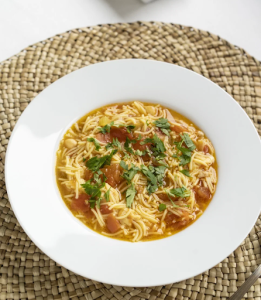
The strongest modern association is with Ramadan. Harira is traditionally served at iftar, the evening meal that breaks the daily fast. In Morocco, it’s commonly accompanied by dates, chebakia (fried dough with honey), eggs, and dried fruit. Because the soup contains legumes, vegetables, and sometimes meat, it provides a good meal after a day of fasting. The Moroccan WIPO study describes it as rich in starch, protein, and fibre, specifically identifying it as the traditional fast-breaking dish during Ramadan. Harira is not restricted to one special day and can be prepared throughout the year. Versions exist across the wider Maghreb, but its importance during Ramadan has made it particularly tied to Moroccan family meals and religious practice.
3. Hot and Sour Soup – China
Hot and sour soup has several related origin stories and regional traditions. The Chinese name, suanla tang, literally means “sour and hot soup,” describing the two flavours that define the dish. Outside China, the soup is frequently described as Sichuan, but that’s not a reliable description of its origins. One important predecessor is hu la tang, or “pepper hot soup,” associated with Henan in northern China. The soup is heavily seasoned with pepper and is traditionally much thicker than the hot and sour soup served in North American Chinese restaurants. Modern hot and sour soup can be understood as part of this wider northern tradition, with vinegar supplying the sour component. Hu la tang has its own uncertain history. Legends connect its development to ancient Chinese dynasties, including stories involving a recipe from a religious community, but these stories can’t be treated as confirmed historical evidence. What can be established more confidently is that pepper-based hot soups became part of northern Chinese food culture and eventually developed into multiple regional forms.
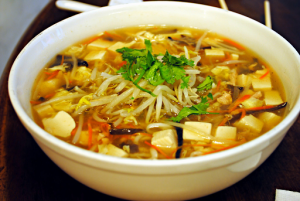
The ingredients of hot and sour soup can vary depending on the version. Traditional hot and sour soup can have tofu, bamboo shoots, wood ear fungus, daylily buds, mushrooms, meat, and egg. The broth contains pepper for heat and vinegar for sourness. Some versions use pork broth, while others use different meats or stocks. The distinction between regional versions becomes important when looking at the soup outside of China. For example, the North American version is often thickened with cornstarch, which gives the broth a glossy, gravy-like consistency. Ingredients can also be frequently substituted according to local availability.
The flexibility isn’t unusual for Chinese cuisine because it contains an enormous range of regional food traditions. A dish labelled as “Chinese” can conceal significant differences in preparation and ingredients. Hot and sour soup is a good example: the version familiar to one part of a region is only one branch of a much larger family of sour and spicy soups.
4. Tom Yum – Thailand
Tom yum is closely associated with central Thailand, particularly the communities that developed around the Chao Phraya River basin. The soup is built around a combination of sour, spicy, salty, and aromatic flavours with ingredients such as lemongrass, galangal (woody root), lime, chilli, and fish sauce. The name itself describes the cooking process. Tom refers to boiling, while yam refers to a style of mixing ingredients and seasoning them with contrasting flavours. There are many forms of tom yum, but tom yum kung, made with shrimp, is one of the best known.
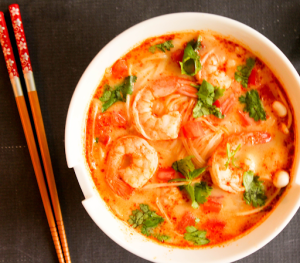
The connection between tom yum and shrimp is geographical. Riverside communities have depended on freshwater resources for centuries, and shrimp became an important ingredient in central Thai cooking. The Thai Ministry of Foreign Affairs describes clear tom yum, or tom yum namsai, as a traditional central Thai preparation, while related versions in northeastern Thailand are known as tom sab and can use fish, frog, or local chicken instead.
Written records provide a particularly useful clue about the soup’s development. A recipe for tom yum kung song khrueng appeared in a Siamese cookbook in 1898. This early recipe was not identical to the modern dish, but it establishes that a shrimp-based tom yum was already being prepared in Siam by the end of the nineteenth century. A recipe much closer to the modern tom yum kung appeared in 1964 in Food of the Royal, showing that the dish changed during the twentieth century. The 1964 recipe also gives a good idea of how the broth was constructed. Shrimp shells and heads were boiled to make the stock, followed by ingredients such as lemongrass and kaffir lime leaves. The cooked shrimp were then added, with lime juice, fish sauce, and chilli used to finish the soup.
Tom yum has since developed into numerous varieties, but the ingredients can change while the basic flavour structure remains recognizable.
5. Rasam – India
Rasam is the least straightforward dish to describe as a soup. In South Indian cuisine, it’s generally a thin, spiced preparation served with rice, often as one course within a larger meal. It is a light preparation with a thin, watery consistency. The dish is found across several South Indian states, including Tamil Nadu, Karnataka, Andhra Pradesh, Telangana, and Kerala, but it goes by different names depending on the region. In Karnataka, a related preparation is called saaru, while Telugu-speaking regions use the name chaaru. The word rasam is derived from the Sanskrit rasa, referring to juice, essence, or flavour.
There’s no reliable historical record identifying one person as the inventor of rasam. Instead, the dish appears to have developed gradually through regional South Indian cooking. Tamarind is common, but kokum or tomato can also provide the sour base. Black pepper, cumin, mustard seeds, dried chillies, garlic, and curry leaves are frequently used, while some versions include lentils, pineapple, or lemon.
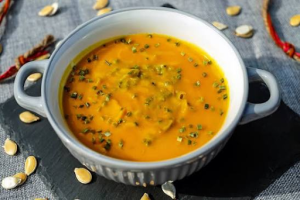
The relationship between rasam and mulligatawny soup adds another chapter. During British colonial rule in India, British cooks adapted South Indian dishes to their own cooking traditions. The word mulligatawny comes from Tamil milagu thanni, meaning “pepper water,” and the earliest versions were much closer to a thin South Indian broth than the substantial soup known today. References to mulligatawny appear in English-language sources as early as 1784, and by the nineteenth century the soup had become popular in Britain. British versions incorporated meat, lentils, and other ingredients, which produced a much heavier dish than the South Indian preparation from which the name originated. By 1827, a cookbook writer named William Kitchiner described mulligatawny as fashionable in Britain. Rasam itself has continued along its own path in South India, with regional varieties still being prepared today.
Conclusion
There are still hundreds of soups left out of this list. Every country has more than one famous soup. Every region has its own ingredients, cooking habits, and recipes that have been shaped over generations. That also means there is no single version of most traditional soups. A family recipe can be different from the one made down the street, which can differ from the version served in another country. The variety is probably the best reason to keep looking. Behind every familiar dish is another recipe, another region, and another piece of history waiting to be found. And, of course, another bowl of soup.
References
Graham, R. (2015, June 17). What pho can teach us about the history of Vietnam. National Geographic.
Koehler, J. (2024, March 8). To break the Ramadan fast in Morocco, start with soup. National Geographic.
Vietnam National Authority of Tourism. (n.d.). The history of pho. Vietnam Travel.
World Intellectual Property Organization. (2021). Scoping study on the creative economy and traditional culinary knowledge in Morocco. WIPO.
Culture Compass: Thai Cuisine Explained Part I – สถานเอกอัครราชทูต ณ กรุงลิมา. (2026). สถานเอกอัครราชทูต ณ กรุงลิมา.
Elevating Thai Cuisine on the Global Stage – กระทรวงการต่างประเทศ. (2025). กระทรวงการต่างประเทศ.
Rosenberger, B. (1980). Cultures complémentaires et nourritures de substitution au Maroc (XVe-XVIIIe siècles). Annales. Histoire, Sciences Sociales, 35(3–4), 477–503.
Bond, M. (2015, July 10). Local flavour: Pho in Hanoi. National Geographic.
Ministry of External Affairs, Government of India. (2017). Rasam. India Perspectives, 31(4), 88–89.
Ministry of Foreign Affairs of the Kingdom of Thailand. (2024). Culture, ways of life and wisdom: Part 2. Government of Thailand.
Radhakrishna, S. (2015). Annapurni: Heritage cuisine from Tamil Nadu. Roli Books.
The story of Vietnamese pho. (2026). Vietnam Tourism.
Vietnam+. (2026, March 19). Vietnamese pho seeks UNESCO Intangible Cultural Heritage of Humanity Status.
Leong-Salobir, C. (2011). Food culture in colonial Asia: A taste of empire. Routledge.
Burton, D. (1994). The Raj at table: A culinary history of the British in India. Faber & Faber.
Padmanabhan, C. (2023). Simply South. Nasadiya Technologies.