Written By: Irene Maneesh Mathew
Written On: July 12th, 2026
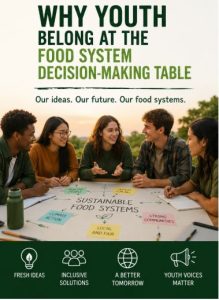
Why Youth Belong at the Food System Decision-Making Table
When people discuss the future of food systems, the conversation often centers on governments, scientists, farmers and industry leaders. While these groups play vital roles, one voice is still often overlooked: youth. As climate change, food insecurity, biodiversity loss and rising food costs reshape the way food is produced, distributed and consumed, young people will inherit the consequences of today’s decisions. More importantly, they are already helping to shape solutions. The question is no longer whether youth should be involved in food system decision-making, but why they are still not consistently given a meaningful seat at the table.
Young people are not simply the next generation of leaders, they are the leaders of today. Across the world, youth are launching community gardens, advocating for food justice, developing agricultural technologies, reducing food waste and promoting sustainable farming practices. Many are using digital platforms to connect farmers with consumers, educate their peers about nutrition and raise awareness about climate-smart agriculture. Having grown up in an era of rapid technological advancement and global connectivity, young people often approach challenges with creativity, adaptability and a willingness to embrace innovation. These qualities are exactly what food systems need as they face increasingly complex environmental and social pressures.
Beyond innovation, young people have a direct stake in the future of food systems. Decisions made today about agricultural policies, land management, climate adaptation, food safety and nutrition will shape the world they live in for decades to come. According to the Food and Agriculture Organization of the United Nations, there are approximately 1.3 billion people between the ages of 15 and 24 worldwide, making youth one of the largest demographic groups globally. Despite this, they remain significantly underrepresented in many decision-making spaces where policies affecting their futures are developed.
Excluding youth from these conversations means overlooking valuable perspectives and lived experiences. Young people often understand the realities of food insecurity, unemployment, environmental degradation and changing consumer behaviors in ways that differ from older generations. Their experiences can help policymakers develop more responsive, equitable and forward-looking solutions. Diversity in decision-making has long been associated with stronger governance and age diversity is no exception.
However, meaningful youth participation requires more than symbolic inclusion. Too often, young people are invited to conferences or advisory meetings simply to demonstrate inclusivity, while having little influence over actual decisions. Genuine participation means involving youth throughout the entire policy process, from identifying challenges and designing solutions to implementing programs and evaluating outcomes. When young people are treated as equal partners rather than passive observers, they contribute ideas that strengthen both policies and institutions.
International organizations have increasingly recognized the importance of youth engagement. Initiatives such as the World Food Forum and the United Nations Food Systems Coordination Hub have created platforms that enable young people to contribute directly to global discussions on food systems, agriculture and sustainability. These efforts acknowledge that achieving the United Nations Sustainable Development Goals, particularly those related to zero hunger, climate action and responsible consumption and production will require collaboration across generations.
Meaningful youth engagement also means ensuring that opportunities are accessible to a diverse range of young people. Rural youth, Indigenous youth, women and those from marginalized communities often face additional barriers to participation in decision-making. Their perspectives are essential because they frequently experience the greatest impacts of food system challenges while also possessing valuable local knowledge and innovative solutions. Inclusive governance must therefore prioritize not only youth representation but also diversity within youth participation itself.
Supporting young people also requires investment. Leadership training, mentorship opportunities, funding for youth-led initiatives and positions on advisory councils with genuine decision-making authority can help transform participation into partnership. Rather than viewing youth as future contributors, governments, organizations and institutions should recognize them as capable changemakers whose insights can improve policies today.
Creating resilient and sustainable food systems will require bold thinking, collaboration and long-term vision. Young people bring all three. They understand emerging technologies, communicate across digital networks and often approach challenges with optimism and a strong sense of social responsibility. Their voices add perspectives that complement the expertise of researchers, farmers, policymakers and industry leaders.
The future of food systems cannot be built without the people who will live with its outcomes the longest. Giving youth a meaningful seat at the decision-making table is not simply about fairness or representation. It is about making better decisions. By listening to, investing in and partnering with today’s youth, we strengthen our ability to create food systems that are more sustainable, resilient and equitable for generations to come.

References
Food and Agriculture Organization of the United Nations (FAO). (2014). Youth and Agriculture: Key Challenges and Concrete Solutions. https://www.fao.org/sustainable-food-value-chains/library/details/en/c/265736/. Accessed July 10th, 2026.
Food and Agriculture Organization of the United Nations (FAO). (2022). The State of Food and Agriculture 2022: Leveraging Automation in Agriculture for Transforming Agrifood Systems. https://www.fao.org/publications/fao-flagship-publications/the-state-of-food-and-agriculture/2022?utm_. Accessed July 10, 2026.
United Nations. (2015). Transforming Our World: The 2030 Agenda for Sustaina
ble Development. https://sdgs.un.org/2030agenda?utm_. Accessed July 11, 2026.
United Nations Food Systems Coordination Hub. (2021). United Nations Food Systems Summit 2021: Action Tracks and Youth Engagement. https://www.unfoodsystemshub.org/?utm_. Accessed July 11, 2026.
World Food Forum. (2023). Youth Action Initiative. https://youth.world-food-forum.org/en. Accessed July 11, 2026.