
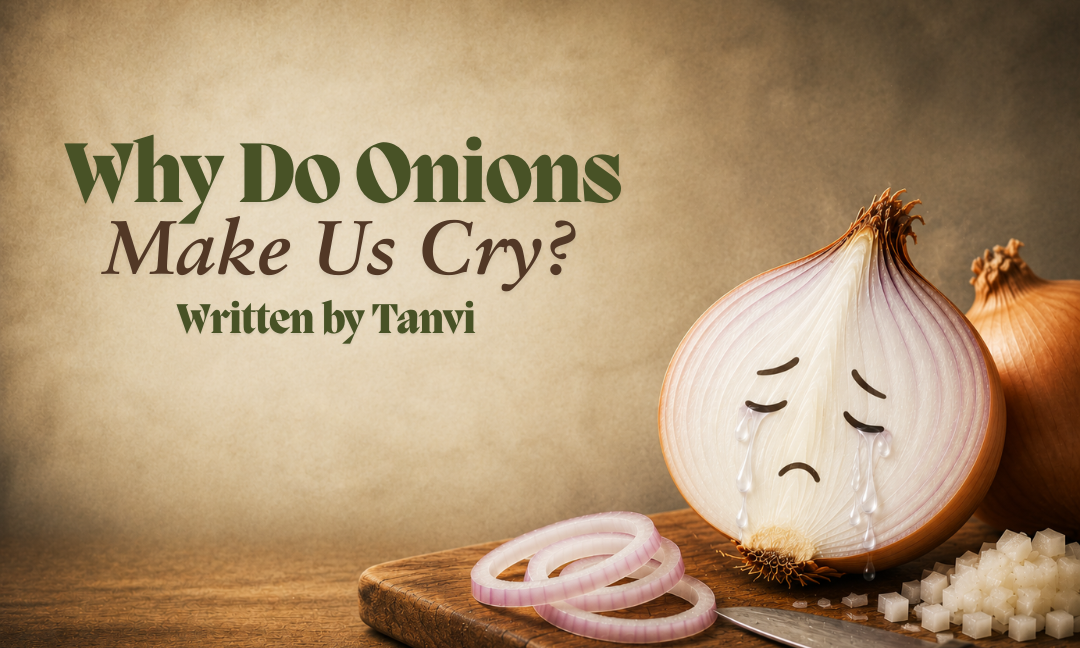
Written By: Tanvi
Edited By: Ocean Croft
Designed By: Polina
Published By: Autumn Diamond
You’re helping make dinner and slicing an onion on a cutting board. Everything seems normal for the first few seconds. Then your eyes start to sting. A moment later, tears are streaming down your face as if you’ve just watched the saddest movie ever made. The strange part is that nothing emotional happened. You simply cut an onion. This familiar kitchen experience has puzzled people for centuries. Why would a vegetable make us cry? The answer lies in a fascinating chain of chemical reactions that begins the moment an onion is sliced open.
At first glance, an onion looks pretty harmless. However, beneath its papery skin is a surprisingly sophisticated defense system. Onions grow underground, where they are vulnerable to insects, animals, and microorganisms. Since they cannot run away from danger, they have evolved a chemical method of protecting themselves. Inside an intact onion, certain compounds are stored separately from specific enzymes. As long as the onion remains uncut, these substances never interact. Everything stays neatly organized within the plant’s cells. The moment a knife slices through the onion, though, thousands of cells rupture. Suddenly, the enzymes and sulfur-containing compounds mix together and begin reacting. This is where chemistry becomes interesting.
The damaged cells produce unstable substances called sulfenic acids. These compounds are quickly transformed into a volatile chemical known as syn-propanethial-S-oxide. Although the name sounds complicated, its effect is simple. The chemical becomes a gas and rises into the air. Unfortunately, that gas often travels directly toward your face. When syn-propanethial-S-oxide reaches your eyes, it dissolves in the thin layer of moisture covering their surface. Your eyes are extremely sensitive, and they immediately recognize the chemical as an irritant. In response, nerve endings send distress signals to your brain.
 Your brain reacts quickly. It instructs the tear glands to produce more tears in an attempt to wash away the irritating substance. Essentially, your eyes are activating their built-in cleaning system. The tears are not caused by sadness or emotion. Instead, they are a protective reflex designed to keep your eyes safe. As a result, you end up crying over a vegetable. Interestingly, not all onions cause the same level of discomfort. Some varieties contain higher concentrations of sulfur compounds than others. Yellow and white onions are often more irritating because they tend to have stronger flavors and more sulfur-containing chemicals. Sweet onions, on the other hand, usually cause fewer tears because they contain lower levels of these compounds.
Several factors can influence how intensely an onion affects you. The freshness of the onion, it’s growing conditions, and even the amount of sulfur present in the soil where it was grown can affect the concentration of tear-inducing chemicals. People also react differently. Some individuals barely notice any irritation, while others begin tearing up almost immediately. Eye sensitivity varies from person to person, which helps explain why one cook may be perfectly comfortable while another struggles to finish chopping a single onion.
Over the years, people have invented countless tricks to avoid onion tears. Some are based on science, while others are more myth than fact. One of the most effective methods is chilling the onion before cutting it. Lower temperatures slow down the chemical reactions responsible for producing the irritating gas. Consequently, less of the substance reaches your eyes. Using a sharp knife can help as well. A dull blade crushes more cells as it cuts, releasing larger amounts of the irritating compounds. A sharp knife creates cleaner cuts and causes less damage to the onion’s tissues. Good ventilation makes a difference too. A fan, kitchen vent, or open window can help move the gas away before it reaches your face. Some people even wear goggles while chopping onions. It may look unusual, but it works because the irritant cannot reach the eyes.
Despite popular claims, some traditional remedies have little scientific support. Holding bread in your mouth or chewing gum might make you feel better, but these tricks generally do not stop the chemical reaction that causes tearing. Scientists have studied onion chemistry for decades, and researchers continue to learn more about how these plants produce their defensive compounds. In fact, some agricultural scientists have even developed varieties of onions designed to reduce or eliminate the tear-producing effect. Nevertheless, many experts note that the same sulfur compounds responsible for making us cry also contribute to the onion’s distinctive flavor. In other words, the tears may be part of the price we pay for that rich, savory taste.
The next time an onion leaves you wiping your eyes, remember that you’re witnessing a remarkable example of plant chemistry in action. What feels like a minor kitchen annoyance is actually the result of millions of years of evolution, complex biochemical reactions, and your body’s natural defense mechanisms working together. Not bad for a vegetable that spends most of its life underground.
References
All About Vision. (n.d.). Why do onions make you cry? All About Vision. https://www.allaboutvision.com/resources/human-interest/why-do-onions-make-you-cry/
Encyclopaedia Britannica. (n.d.). Why do onions make you cry? Britannica. https://www.britannica.com/story/why-do-onions-make-you-cry
Library of Congress. (n.d.). Why does chopping an onion make you cry? Everyday Mysteries. https://www.loc.gov/everyday-mysteries/food-and-nutrition/item/why-does-chopping-an-onion-make-you-cry/
Poison Control. (n.d.). Why do onions make you cry? https://www.poison.org/articles/why-do-onions-make-you-cry
Whelan, C. (2020, September 22). Why do onions make you cry? Enzymes, treatments & more. Healthline. https://www.healthline.com/health/why-do-onions-make-you-cry
Live Science. (2025, October 17). Why does slicing onions make you cry? https://www.livescience.com/why-slicing-onions-makes-you-cry