Written By: Arjun Singh Edited By: Mannat Malhan Designed By: Rashiqa Ali Published By: Khushal Patel
The next time you open a bag of cheese puffs, breakfast cereal, or even some plant based chicken nuggets, take a second to think about how it was made. These foods are made using a process called extrusion cooking, which uses heat, pressure, and moisture to change the texture and structure of food ingredients.
It might seem like something that could be done with regular cooking methods, but the light and crunchy texture of foods like cheese puffs is actually created through a much more controlled process. Food manufacturers use an extruder to apply heat and pressure to ingredients such as corn, rice, wheat or plant proteins. When the material leaves the machine, a rapid change in pressure causes it to expand and form the familiar puffed texture.
To understand how this happens, it helps to look at the machine itself. An extruder is a large piece of equipment that pushes food ingredients through a long barrel using one or two rotating screws. You can think of it as a combination of a pressure cooker and a machine continuously rushes dough forward.
The process starts with relatively simple ingredients. A mixture might contain cornmeal, rice flour, wheat, or another type of grain, along with a controlled amount of water. At this stage, the mixture still looks more like a coarse flour or dough than a finished food.
As the screws rotate, they move the mixture through the barrel. The space inside becomes more restricted, increasing both pressure and temperature. Friction from the movement of the material and the screws also contributes to the heat. Under these conditions, the starches in the ingredients begin to change, They absorb water and become softer and more fluid, creating a hot thick mixture. 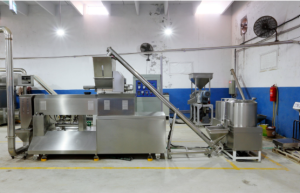
One interesting part of the process is what happens to the water. Under normal atmospheric pressure, water boils at around 100 degrees celsius. Inside an extruder, however, the pressure is much higher, which allows the water to remain in a liquid state even at temperatures above its normal boiling point.
The most important part happens when the mixture reaches the end of the barrel. It is forced through a small opening called a die, which gives the food its final shape
As soon as the hot mixture leaves the die, the pressure drops suddenly. The water inside the mixture can then rapidly turn into steam. Because the steam takes up much more space than liquid water, it causes the material to expand. This creates the light, porous structure found in many puffed foods.
The expanded product is then dried to remove additional moisture. After that, manufacturers can add seasonings or other ingredients, such as the cheese-flavoured coating found on many cheese puffs 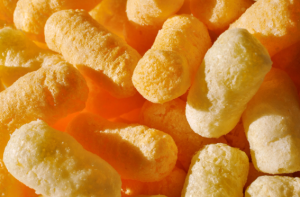
Although extrusion is useful for creating interesting textures, its importance goes beyond making snacks. The process is also valuable because it can be efficient, flexible, and useful for producing a wide range of foods.
Food production creates materials that are not always sold as whole products. Broken grains, grain pieces, and materials left over from milling can sometimes be processed into flours or other ingredients instead of being discarded.
Extrusion can then turn these ingredients into products with different textures and uses, This can help manufacturers get more value from the crops they purchase and potentially reduce some forms of food waste
Many extruded foods have relatively low moisture levels after processing and drying. Low moisture makes it more difficult for many microorganisms to grow, which can help extend the shelf life of the finished product.
This is particularly useful for foods that need to be transported and stored for long periods, products that do not require refrigeration are generally easier to package, ship, and store , which can make distribution more convenient
Extrusion is also being used in the development of plant based meat products. Ingredients such as soy and pea protein can be proceeds under carefully controlled conditions of heat moisture and pressure.
During this process, the proteins can form structures that give the finished product a more fibrous texture. By adjusting the processing conditions, manufacturers can create plant based products designed to have a texture that resembles food such as chicken or beef.
So, the crunch of a cheese puff is more than just a convenient snack texture. It is the result of a carefully controlled process that combines food science, engineering, and manufacturing. The same basic technology can also be used for the products that are designed to have longer self lives, make better use of ingredients, and create new sources of plant based proteins.
References:
Dayi Food Solution. (n.d.). The method and principle of the puffing process. https://dayifoodindustry.com/the-method-and-principle-of-puffing-process/
Li, K., Zhao, Y., Wang, S., Zhang, Y., & Sui, X. (2026). Structural, textural, and functional properties of plant-based meat analogs prepared by high-moisture extrusion of soy–wheat–mung bean multi-protein system. Foods, 15(5), 824. https://doi.org/10.3390/foods15050824
Sui, X., Zhang, T., Zhang, X., & Jiang, L. (2024). High-moisture extrusion of plant proteins: Fundamentals of texturization and applications. Annual Review of Food Science and Technology, 15, 125–149. https://doi.org/10.1146/annurev-food-072023-034346
Food extrusion. (n.d.). In Wikipedia. Retrieved August 19, 2026, from https://en.wikipedia.org/wiki/Food_extrusion
Shandong Loyal Industrial Co., Ltd. (2025, September 27). Complete guide to food extrusion technology. https://loyal-foodmachine.com/food-extrusion-process/
The impact of extrusion cooking on the physical properties, functional components, and pharmacological activities of natural medicinal and edible plants: A review. (2025). Foods, 14(11), 1869. https://doi.org/10.3390/foods14111869