Written By: Valerie Belopolsky
Edited By: Mannat Malhan
Designed By: Harneet Khurana
Published By: Valerie Belopolsky
As of 2025, nearly 2.4 million children in Canada live in food-insecure households. To finally address food insecurity across Canada, the government of Canada signed bilateral agreements with all provinces and territories, First Nations, Inuit, and Métis communities, as well as self-governing and modern treaty partners, to establish the National School Food Program Act. Funding from all parties provided will be used to enhance and expand school food programming across Canada to allow for healthier, locally sourced meals for more students, employ more staff, and invest in proper equipment and infrastructure, in turn, investing in the future of kids. Previously, Canada was the only G7 country with no national school food program. The National School Food Program Act officially became a law in Canada when it received Royal Assent through Bill C-15 on March 26, 2026. 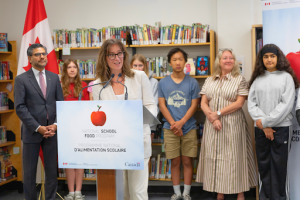
The National School Food Program Act was established to ensure all kids and youth have access to nutritious meals during the school day, designed to provide meals to up to 400,000 more children annually, supported by $1 billion in federal investment over five years. Following royal assent, annual federal funding for provinces and territories has doubled to $140 million, with permanent funding set to increase to $216.6 million per year starting in 2029-30.
The Act aims to combat food insecurity within low-income families, ensuring all children receive proper sustenance during the school day to reach their full potential. Nearly one in four children does not get enough food, impacting their opportunities to learn and develop. According to studies, students who consistently consumed a nutritious breakfast attained higher grades in reading, math, and science compared to their peers who didn’t. For students, a nutritious meal furthers academic success, promotes equity and healthy eating, and guarantees available, nutritious food systems. For the average family, the program is expected to save up to $800 annually in grocery expenses and relieve parents’ stress by ensuring schools will support their children’s nutritional needs.
A key component of the school food program is that disability benefits are not counted as income, unlike in other programs where clawbacks are common. A “clawback” happens when the government reduces or takes back part of a benefit because someone is receiving other income or support. The program allows CBD to stay as additional financial support. Particularly significant in the context of food insecurity within Canada since nearly 1 in 3 food bank clients report living with a disability or chronic health condition, making individuals on disability a prominent demographic.
This upcoming school year, more than 10,000 schools are offering school food programs. Across Canada, schools provide distinct food programming to meet the diverse regional needs of local communities. These programs can be pay-what-you-can or reduced-cost lunch programs, grab-and-go snack bins available throughout the day, school gardens where students help grow ingredients used in meals, free breakfasts served before class, and community meals with a diverse menu incorporating country food. Each different program caters to student needs, working toward a collective goal—for all students to receive universal access to school meals without stigma for a more equitable learning space.
The National School Food Program Act is a step forward for Canada’s poverty reduction plan. However, food insecurity continuously rises, the most prominent factors being dilapidated incomes and inflation. The food program simply serves as a mitigation measure, not a solution. For meaningful, drastic change that is necessary to combat food insecurity within Canada, government policies must tackle root problems.
Sources:
Government of Canada. (2024, June 20). National School Food Policy.
https://www.canada.ca/en/employment-social-development/programs/school-food/reports/national-policy.html
New Release: 2025 Report Card on Child and Family Poverty in Canada – Campaign 2000. Campaign 2000.
https://campaign2000.ca/new-release-2025-report-card-on-child-and-family-poverty-in-canada/
Proof. (2014). Household Food Insecurity in Canada – PROOF. Utoronto.Ca; Proof.
https://proof.utoronto.ca/food-insecurity/
Toronto study links breakfast with school success. (2012, May 12). CBC.
https://www.cbc.ca/news/canada/toronto/toronto-study-links-breakfast-with-school-success-1.1179699
MAP policy impact: Federal government makes National School Food Program permanent. (2025, October 14). MAP Centre for Urban Health Solutions.
https://maphealth.ca/map-policy-impact-national-school-food-permanent/
A National School Food Program to set kids up for success. (2024, April 1). Prime Minister of Canada.
https://www.pm.gc.ca/en/news/news-releases/2024/04/01/national-school-food-program-set-kids-success
Taylor, S. (2026, April 2). A step forward in the fight against hunger: Progress in Bill C-15. Daily Bread.
https://www.dailybread.ca/blog/a-step-forward-in-the-fight-against-hunger-progress-in-bill-c-15/
Legislative Services Branch. (2026). National School Food Program Act. Justice.Gc.Ca.
https://lois.justice.gc.ca/eng/acts/n-16.45/fulltext.html