Written By: Irene Mathew
Edited By: Mannat Malhan
Designed By: Polina
Published By: Polina
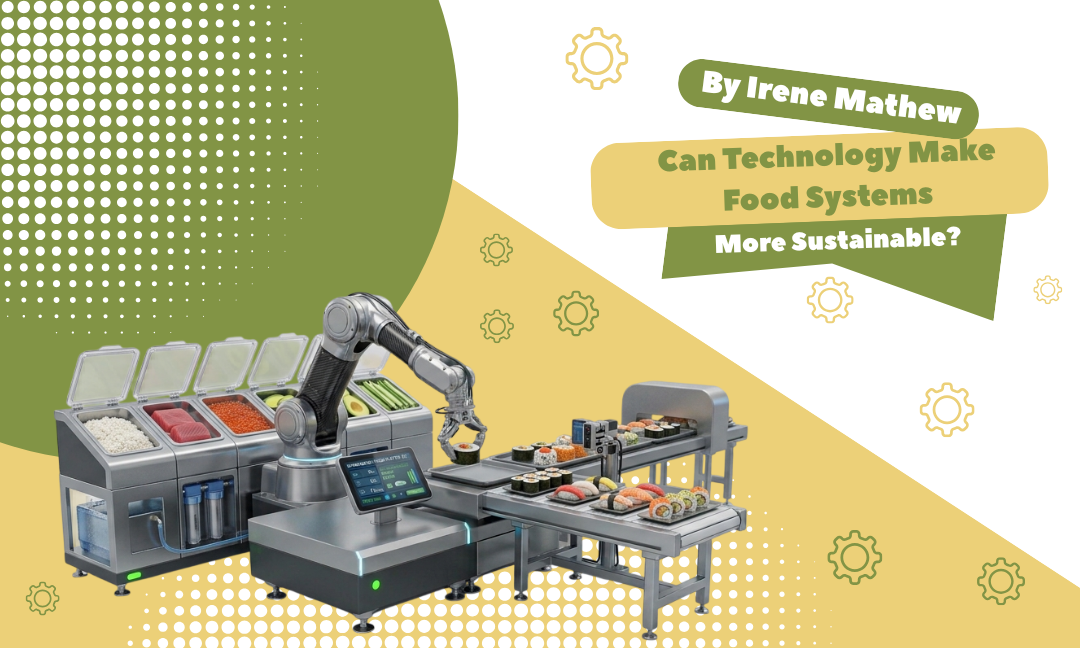
When we think about technology, we often think about smartphones, robots or artificial intelligence (AI). However, technology is also changing something we all depend on every single day: our food. From the moment a seed is planted to the food that ends up on our plates, new technology is helping make food production efficient and environmentally friendly. But can technology really make our food systems more sustainable?
The answer is yes, but technology is not a complete solution. It can help farmers produce more food with fewer resources, reduce food waste, and make supply chains more efficient. However, it must be combined with good policies, education and sustainable farming practices.
As the world’s population continues to grow, so does the demand for food. According to the United Nations, the global population is expected to reach nearly 10 billion by 2050 (United Nations, 2022). Feeding more people while protecting the environment is one of the greatest challenges of our time. Agriculture already uses about 70% of the world’s freshwater and contributes significantly to greenhouse gas emissions (FAQ, 2023). This means we need smarter ways to grow and distribute food.
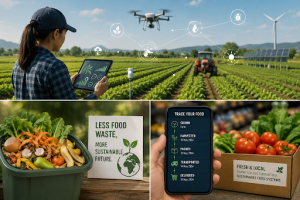
One of the most promising innovations is precision agriculture. Using GPS, drones, sensors and artificial intelligence (AI), farmers can monitor crop health, soil moisture and weather conditions in real time. Instead of applying the same amount of water or fertilizer across an entire field, farmers can target only the areas that need it. This reduces waste, saves money and lowers pollution caused by excess fertilizers entering rivers and lakes.
Technology is also helping farmers adapt to climate change. Weather forecasting tools and AI-powered prediction models allow farmers to prepare for droughts, floods or pest outbreaks before they happen. Mobile apps can provide farmers with advice on planting dates, irrigation schedules and disease management, especially in regions where agricultural experts are difficult to access.
Another major issue is food waste. Roughly one-third of all food produced globally is lost or wasted every year (UNEP, 2024). New technologies are helping tackle this problem. Smart storage systems monitor temperature and humidity to keep food fresh for longer. Improved packaging extends shelf life, while digital platforms connect restaurants, grocery stores and consumers with surplus food that would otherwise be thrown away. These innovations help reduce waste while making food more accessible.
Technology is also improving transparency in food supply chains. Digital tracking systems can follow food from the farm to the supermarket, helping consumers know where their food comes from and ensuring food safety. Some companies are using blockchain technology to record every step of a product’s journey, making it easier to trace contamination and reduce fraud.
Innovations in food production are expanding beyond traditional farming. Vertical farming grows crops indoors using LED lighting and carefully controlled environments. Although these systems require electricity, they use significantly less land and water than conventional farming and can be located close to cities, reducing transportation emissions. Scientists are also developing alternative proteins, such as plant-based foods and cultivated meat, which may require fewer natural resources than traditional livestock production.
Despite these exciting developments, technology alone cannot solve every challenge. Many farmers, especially in low-income countries, cannot afford expensive equipment or lack reliable internet access. There are also concerns about data privacy, energy use and ensuring that technological advances benefit small-scale farmers rather than only large agricultural companies. Sustainable food systems require fair access to innovation, investment in education and policies that support both environmental protection and economic opportunity.
Young people have an important role to play in this transformation. Today’s students are tomorrow’s scientists, engineers, entrepreneurs, policy makers and farmers. By learning about sustainable agriculture, supporting local food systems, reducing food waste at home and encouraging responsible innovation, youth can help shape a food system that is both productive and environmentally responsible.
Looking ahead, technology has enormous potential to make food systems more sustainable. Precision agriculture, AI, digital supply chains, smart storage and innovative food production methods can all help reduce environmental impacts while improving food security. However, lasting sustainability depends not only on technological innovation but also on collaboration among governments, farmers, researchers, businesses and communities. By combining technology with sustainable practices and inclusive policies, we can build a food system that feeds future generations while protecting the planet.
References
Food and Agriculture Organization of the United Nations (FAO). (2023). The State of Food and Agriculture 2023: Revealing the true cost of food to transform agrifood systems. Rome: FAO, https://www.fao.org/publications/fao-flagship-publications/the-state-of-food-and-agriculture/2023/en, Accessed June 30, 2026.
United Nations Environment Programme (UNEP). (2024). Food Waste Index Report 2024. Nairobi: UNEP, https://www.unep.org/resources/publication/food-waste-index-report-2024?os=vb, Accessed June 30, 2026.
United Nations. (2022). World Population Prospects 2022: Summary of Results. Department of Economic and Social Affairs, Population Division, https://population.un.org/wpp/, Accessed July 1, 2026.
Advancing sustainability: The impact of emerging technologies in agriculture, https://www.sciencedirect.com/science/article/pii/S2214662824001026, Accessed July 1, 2026