Written By: Arjun Singh
Edited By: Ayman Anas Khan
Designed By: Harneet Khurana
Published By: Polina
When we think of farm or barn animals, we usually picture cows, chickens, or pigs. However, there is a massive, highly organized agricultural workforce that most of us never see, consisting of billions of tiny livestock: the commercial honeybee. Furthermore, without these rented insects, the modern, globally connected food system would collapse. It is estimated that one out of every three bites of food we eat depends directly on insect pollination.
Here is a look at the massive, cross-country logistics of migratory bee keeping, and how renting millions of bugs is the secret engine of our agricultural economy:
To understand why we need to rent bees, we have to look at how food is produced today. In the modern day, farming relies on monocultures, planting massive, continuous fields of a single crop, like hundreds of acres of nothing but apples or pumpkins.
Moreover, this is incredibly efficient for harvesting, but it creates a biological desert for most of the year. Natural, wild pollinators cannot survive in an environment that only offers flowers for two weeks out of the year and provide nothing but green leaves the rest of the time.
So, when those thousands of acres suddenly burst into bloom, there aren’t enough local insects to pollinate the blossoms. If a blossom doesn’t get pollinated, it doesn’t turn into a piece of fruit. The solution? Farmers have to literally truck in an army of pollinators exactly when the flowers open, and truck them out the moment the bloom is over.
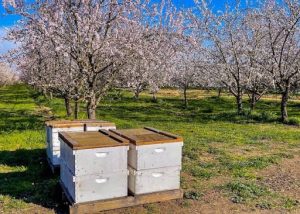
The undisputed heavyweight champion of the commercial pollination world is the California almond industry. Almond trees are almost entirely dependent on cross pollination; without bees moving pollen from one variety of tree to another, the crop yield drops from thousands of pounds per acre down to a few hundred.
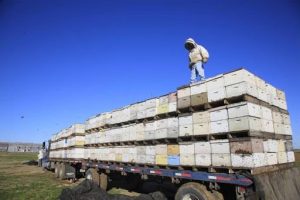
For example, California produces about 80 percent of the world’s almonds. To make that happen, they need astronomical numbers of bees. Every February, in what is often called called the largest pollination event in the world, over 2 million honeybee colonies representing merely 90 percent of all commercial hives in the United States are loaded onto flatbed semitrucks and driven to California’s central valley.
These bees don’t just stay in California. After the short almond bloom finishes in mid march the great migration begins, beekeepers strap the hives back onto commercial haulers, cover them with specialized netting, and drive through the night while the bees are sleeping inside their boxes. The trucks fan out across the country, following the changing seasons and blooming crops:
Spring: From California, trucks might head to Washington state to pollinate apples and cherries or down to Florida for citrus and watermelons.
Summer: the hives move to the midwest and northwest to pollinate blueberries, pumpkins, cucumber, and cranberries.
Later summer/fall: many beekeepers finally settle their hives in the upper midwest (like the Dakotas) where the bees can forage on clover and wildflowers, producing the actual honey that the beekeeper will harvest and sell.
Winter: the bees are moved to warm southern states or specialized climate controlled indoor holding facilities to rest and rebuild their strength before the next almond season begins.
 For decades, commercial beekeepers made most of their money selling honey. But as global honey prices dropped and the demand for almonds skyrocketed, the economy flipped. Today, renting out bees is the primary source of income for most commercial beekeepers. Almond growers pay top dollar, often over 200 USD per hive, for the short pollination window because the financial risk of a failed crop is so high. Growers even hire third party inspectors to open the rented boxes and count the frames of bees to ensure the beekeepers delivered a strong, healthy workforce.
This system is a logical miracle, but it puts immense stress on the bees. Being bounced down the highway on a semi truck exposed to different agricultural chemicals at every stop and feeding on single crop diets takes a heavy toll on hive health.
So the next time you eat an almond, a blueberry, or a slice of watermelon, remember that its existence likely relied on a wooden box of insects that traveled more miles across the country than most human do in a year.
References:
Fenton, M., Goodrich, B. K., & Penn, J. (2025). Measuring beekeepers’ economic value of contract enhancements in almond pollination agreements. Ecological Economics, 227, Article 108351. https://doi.org/10.1016/j.ecolecon.2024.108351
Garvey, K. K. (2008, October 1). What price pollination? Bug Squad, University of California Agriculture and Natural Resources. https://ucanr.edu/blog/bug-squad/article/what-price-pollination
Goodrich, B., & Altschuler, A. (2025, February 17). Where have all the honey bees gone? To California almond orchards. farmdoc daily, 15(30). https://farmdocdaily.illinois.edu/2025/02/where-have-all-the-honey-bees-gone-to-california-almond-orchards.html
Illinois, University of. (2024, October 15). Honey bees in demand: New contract strategies to support pollination services. College of Agricultural, Consumer and Environmental Sciences. https://aces.illinois.edu/news/honey-bees-demand-new-contract-strategies-support-pollination-services
Rucker, R. R., Thurman, W. N., & Burgett, M. (2012). Honey bee pollination markets and the internalization of reciprocal benefits. American Journal of Agricultural Economics, 94(4), 956–977. https://doi.org/10.1093/ajae/aas031
Hurley, P. (2020). Zombie fields: Ethical concerns of pollination in industrial agriculture [Ethics essay]. University of Maine Honors College. https://honors.umaine.edu/wp-content/uploads/sites/184/2020/10/Pat-Hurley-1st-Place-Rezendes-Ethics-Essay-2020.pdf
California State Assembly Committee on Agriculture. (2025). Assembly Bill 1042: Policy committee analysis. California State Assembly. https://agri.assembly.ca.gov/system/files/2025-04/asm-ag-analysis-ab-1042.pdf
Wilder, E. (2018, August 17). Bees for hire: California almonds become migratory colonies’ biggest task. & the West, Stanford University. https://andthewest.stanford.edu/2018/bees-for-hire-california-almonds-become-migratory-colonies-biggest-task/