Written By: Irene Mathew
Edited By: Ocean Croft
Designed By: Danujan Krishnakumar
Published By: Valerie Belopolsky
When people think about climate change, they often picture melting glaciers, rising sea levels, or extreme weather events. However, climate change is also affecting something much closer to us, our food. The fruits, vegetables, and other foods we eat every day are becoming increasingly impacted by changing weather patterns. From higher food prices to shortages of certain crops, climate change is beginning to shape what ends up on our plates. 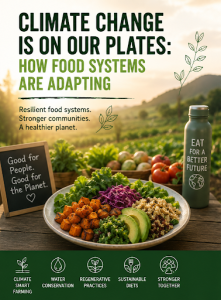
Food systems include everything involved in getting food from farms to our tables, such as growing, processing, transporting, and selling food. Unfortunately, every part of this system is vulnerable to climate change, as farmers around the world deal with hotter temperatures, longer droughts, stronger storms, and unpredictable rainfall than ever before. These changes make it more difficult to grow crops and raise livestock.
For example, heat waves can damage crops like wheat and corn, while heavy flooding can ruin entire harvests. In some regions, farmers are also seeing an increase in pests and plant diseases because warmer temperatures allow them to survive longer. According to the Intergovernmental Panel on Climate Change (IPCC), climate change has already slowed agricultural growth and is increasing the risk of food insecurity worldwide (IPCC, 2022).
Although these challenges are serious, food systems are adapting in many creative ways.
One important solution is climate-smart agriculture. This approach helps farmers produce food by using methods that lessen the impact of changing weather conditions. For example, many farmers are planting drought-resistant crops that can survive with less water. Others are using drip irrigation systems, which deliver water directly to plant roots and reduce waste. Some farmers are also rotating crops and planting cover crops to improve soil health and make their farms more resilient. 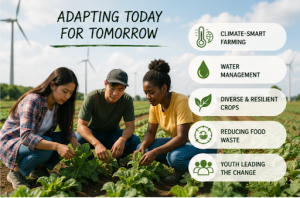
Technology is also helping food systems adapt. Farmers can now use satellites, drones, and sensors to monitor their crops and predict weather conditions. This information allows them to use water and fertilizer more efficiently to avoid unnecessary losses. In cities, some people are turning to vertical farming, where crops are grown indoors in controlled environments. These farms use less land and water and can produce food year-round.
Young people also have an important role to play in creating a more sustainable food system. Across the world, youth are speaking up about climate change and finding new solutions to environmental problems. Some are starting community gardens, reducing food waste, or promoting sustainable farming practices through social media and school projects. Others are pursuing careers in agriculture, environmental science, and food policy to help solve these challenges in the future.
As consumers, young people can make a difference through everyday choices. Reducing food waste, supporting local businesses, and learning more about where food comes from are simple actions that can have a positive impact. Even small lifestyle changes can contribute to building a food system that is more sustainable and resilient. 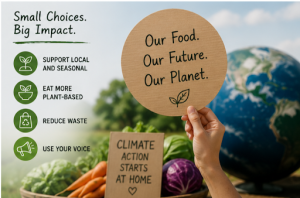
Climate change may be affecting the food on our plates, but it is also encouraging innovation and cooperation. Farmers, scientists, communities, and young people are all working together to adapt to these challenges and protect the future of our food. By continuing to develop new ideas and support sustainable practices, we can help create a food system that can withstand the effects of climate change and provide healthy food for generations to come.
References
Food and Agriculture Organization of the United Nations (FAO). (2021). Climate-smart agriculture. https://www.fao.org/americas/news/news-detail/fao-and-canada-launch-ca-10-million-regional-project/en. Accessed July 13, 2026.
Intergovernmental Panel on Climate Change (IPCC). (2022). Climate Change 2022: Impacts, Adaptation and Vulnerability. Cambridge University Press. https://www.ipcc.ch/report/ar6/wg2/. Accessed July 13, 2026.
United Nations. (2023). The Sustainable Development Goals Report 2023: Special Edition. https://unstats.un.org/sdgs/report/2023/. Accessed July 14, 2026.
World Food Programme (WFP). (2024). Climate Crisis. https://www.wfp.org/climate-and-resilience. Accessed July 14, 2026.