Written By: Arjun Singh
Edited By: Prakhar Sood
Designed By: Ayman Khan
Published By: Valerie Belopolsky
When you think about Canadian food, what comes to mind? Probably poutine, maple syrup, and maybe butter tarts? We all know and love them. But have you ever wondered how they actually started? For Food Day Canada, let’s look past the stereotypes and dive into the surprisingly fun and clever origins of our famous dishes.
Firstly, the biggest Canadian comfort food, poutine as we know it, didn’t always exist. Back in the 1950’s, it was just a quick, localized snack in rural Quebec. The most famous origin story takes place in 1957. A customer allegedly asked a restaurant owner named Fernand Lachance to throw some cheese curds into his bag of fries. Lachance warned him, “ça va te faire une maudite poutine!” (“that will make a damned mess!”). The name in French stuck, and people to this day just call it “poutine”. The hot gravy was actually added a few years later just to keep the fries warm on the plate. Today it is famous worldwide, but the secret to a true poutine remains unchanged: the cheese curds 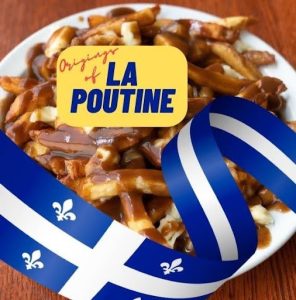 absolutely must squeak when you bite them.
If poutine is Canada’s favourite savoury dish, the butter tart is the undisputed champion of Canadian desserts. A perfectly flaky pastry shell filled with a semi-solid, gooey mixture of butter, sugar, syrup, and egg, the butter tart is unique to Canada. While the very first published recipe appeared in a 1900 hospital cookbook from Barrie, Ontario, the true origins go much further back. Historians believe it was born in the late 1600s with the arrival of the filles du roi (the King’s Daughters) who were French women sent to help colonize New France. They brought traditional European pastry recipes with them but had to adapt them to the rugged ingredients available in their new environment. Today, the butter tart is so beloved that there are entire festivals and tasting tours dedicated to it across Ontario. And it remains the subject of the most intense culinary debate in Canadian history: do raisins belong in a butter tart or not?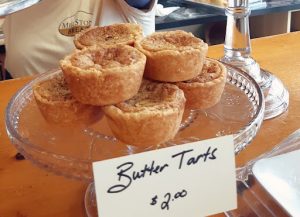
The arguably most important Canadian food and stereotype is maple syrup. Canada produced over 70% of the world’s supply, but the tradition goes far deeper than pouring it over pancakes. Long before European settlers arrived, indigenous peoples in the northeastern part of the continent had perfected the process of tapping maple trees and boiling the sap down into concentrated sugars for energy preservation. One of the most beloved ways to eat and enjoy thus today is tire d’érable or maple taffy.
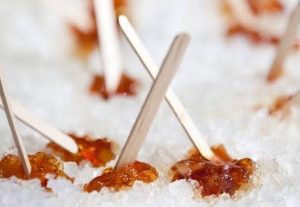 The process is an awesome culinary trick, maple sap is boiled past the point of being syrup until it becomes a thick, molten liquid. It is then poured directly onto clean packing snow. The sudden temperature drop flash freezes the sugar into a chewy, sticky taffy that you immediately roll up onto a wooden stick. It is a brilliant, interactive treat that connects Canada’s landscape and culinary traditions.
Canadian cuisine is hard to define because Canada itself is so vast. However, if there is a common tie that brings dishes like poutine, butter tarts, and maple taffy together, it is an adaptation. These foods weren’t born in elite academics, but rather created by people working with the landscape, using local ingredients, resilient and ours.
References
Evans, T. T. (2022). The Indigenous origins of maple syrup. NMAI Magazine.
https://www.americanindianmagazine.org/Indigenous-origins-of-maple-syrup
The Canadian Encyclopedia. (n.d.). Butter tarts.
https://thecanadianencyclopedia.ca/en/article/butter-tarts
The Canadian Encyclopedia. (n.d.). The history of poutine.
https://thecanadianencyclopedia.ca/en/article/history-of-poutine
Producteurs et productrices acéricoles du Québec. (n.d.). Origins of maple syrup.
https://ppaq.ca/en/maple-sirup/origins-maple-syrup/
County of Simcoe. (2018, January 19). Mrs. Malcolm MacLeod and her recipe for butter tart filling.
https://simcoe.ca/simcoe_archives/mrs-malcolm-macleod-and-her-recipe-for-butter-tart-filling