Written by: Tanvi Jillella
Edited by: Ocean Croft
Designed by: Danujan Krishnakumar
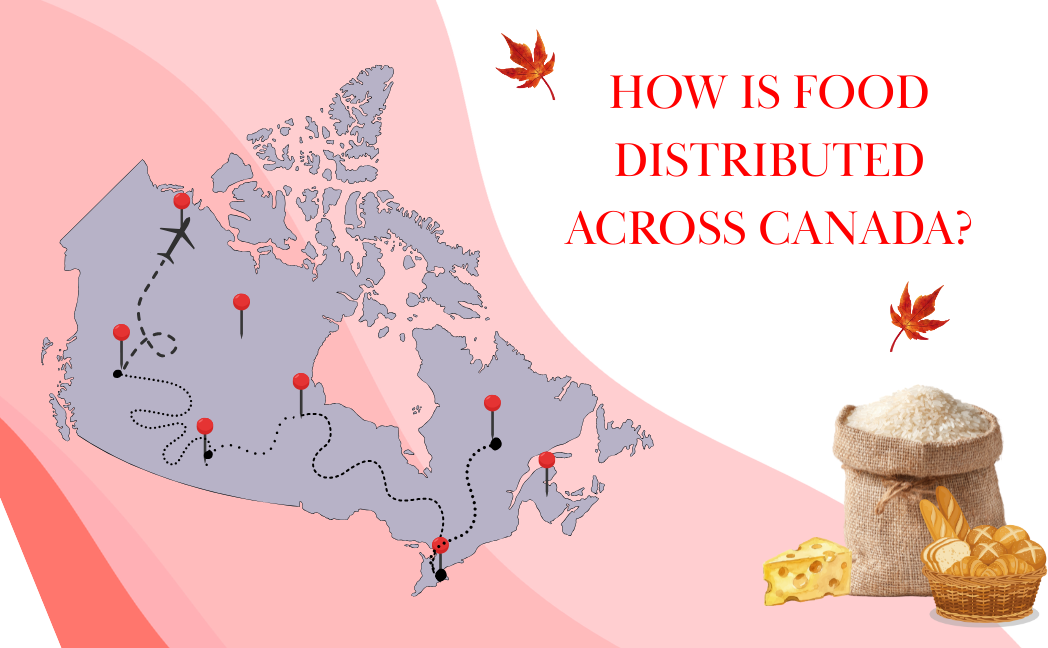
How Food Is Distributed Across Canada
Canada’s food system is a sophisticated network that extends beyond mere agriculture, weaving products through rough terrain, diverse climates and vast distances just to reach store shelves. Canada is a huge country with a spread out population and different climates. Food distribution relies on a highly coordinated system of local production, imports, and long distance transportation.
A big part of Canada’s food supply starts with primary agriculture, which includes work done on farms and in greenhouses. Most farms are concentrated around Southern Ontario, Quebec, and the Prairies, because these regions have the most suitable soil and growing conditions. Canada is especially strong in producing crops like wheat, canola, and barley, which are also its key exports but Ontario also plays a major role in food production. Its specialties are vegetables and dairy, which generated around 2.6 billion dollars in profits each between the four year period of 2020 and 2024. Demonstrating how southern provinces are the backbone of Canadian agriculture.
After crops are harvested, the next stage is processing. Food and beverage processors take raw materials and turn them into products that can be consumed. For example, milk is turned into cheese or yogurt, and grains are processed into bread and packaged foods. This step is important because most food is not eaten in its raw form. Processing also makes food easier to transport and store, which is necessary in a country as large as Canada.
Once processed, food is shipped to wholesalers and retailers through a network of transportation systems. Trucks are the most popular method of transport because they can deliver food directly to stores and distribution centres. Trains are mainly used for transporting bulk goods like grain, over long distances, while ships bring food imported from other countries into major ports such as Vancouver, Montreal, and Halifax. From these entry points, food is transported inland across many provinces via other transportation, like trucks. Because Canada is the second largest country in the world, food may travel up to thousands of kilometres before reaching consumers, making transportation a critical part of the system.
Distribution centres are central hubs for food, as they organize the movement of it across many areas of the food sector. These centres are most commonly located in southern, more densely populated areas for efficient supply to nearby cities. They receive large shipments of food to temporarily store, then distribute them to retailers. Some examples are grocery stores, restaurants, and markets. A popular distribution centre is the Ontario Food Terminal. It handles large amounts of fresh produce from both local farms and international suppliers. Provinces also trade food with each other depending on what they produce. For example, the Prairie provinces supply grain, while Ontario and Quebec supply more dairy and fresh produce.
Even though this system works well in southern Canada, it is very different in northern territories. Areas in the North have limited local agriculture due to harsh climates and poor growing conditions. Because of this, most of their food has to be transported from southern Canada. In many cases, food is flown in or delivered using seasonal roads, which increases costs and limits supply. This results in higher food prices and fewer fresh options for northern territories, especially when compared to southern provinces. This difference illustrates how geography affects food distribution and access.
Canada also relies heavily on imported food, especially for items that cannot be produced year round. A large percentage of fruits and vegetables are imported from warmer countries like the United States and Mexico. Common examples include bananas, oranges, and leafy greens. These products are brought into Canada through international trade and then distributed via transportation and distribution networks. In contrast, foods like wheat, dairy products, and certain meats are mostly produced within Canada and are therefore less dependent on imports. For Canada to thrive, there needs to be a balance between domestic production and imports.
Overall, food distribution in Canada follows a multi-step process that includes production, processing, transportation, and retail. The system depends on southern agricultural regions, efficient transportation networks, and central distribution hubs to move food across the country. At the same time, differences between regions, especially in the North, highlight ongoing challenges in access and affordability. Understanding this system shows that food distribution is not just about where food is grown, but how it moves and reaches people across Canada.
References
Agriculture and Agri-Food Canada. (n.d.). Sector overview. Government of Canada.
https://agriculture.canada.ca/en/sector/overview
Wickramasinghe, S. (2025, January 30). Where do Canada’s fruits and vegetables come from? New website maps the flow into provinces. University of British Columbia.