Written By: Soham Parmar
Edited By: Ocean Croft
Designed By: Harneet Khurana
Imagine walking into a grocery store and picking up a carton of milk, a dozen eggs, or some chicken. These are everyday products that Canadians buy regularly. However, behind these familiar foods is a system that influences how they are produced, priced, and imported. This is known as supply management, which is the system that has played an important role in Canada’s agricultural industry for decades. But where did it come from, and why does Canada still use it today?
How Did It All Begin?
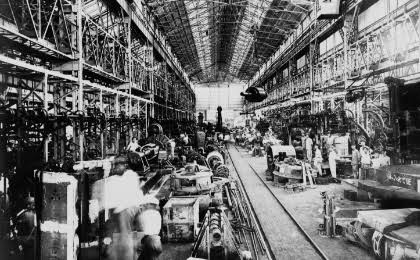 To understand supply chain management, we need to go back to the 1960s. During this time, Canada’s dairy, poultry, and egg industries faced serious challenges. Improvements in farming technology led to overproduction, meaning farmers were producing more products than the market needed. This resulted in low and unstable prices, along with disagreements between farmers and food processors.
Farmers wanted more control over the market and a stronger position when negotiating prices. They began asking provincial governments to establish marketing boards to help manage production and improve their bargaining power. These concerns eventually led to the development of Canada’s supply management system. In 1972, the Farm Products Agencies Act established the national framework for managing these agricultural industries.
How Does Supply Management Actually Work?
Canada’s supply management system is built around three main pillars: production control, pricing mechanisms, and import control.
- Production Control
Farmers receive production limits known as quotas. These determine how much of a certain product they are allowed to produce. National agencies establish production levels based on expected demand, and provincial marketing boards distribute those limits among farmers. This helps prevent excessive production and supply shortages.
-
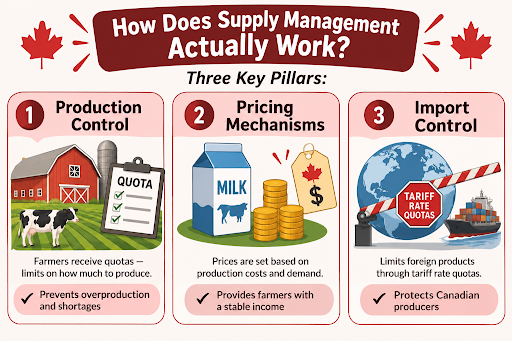 Pricing Mechanisms
Instead of relying entirely on changing market prices, supply management uses pricing mechanisms that consider production costs, market conditions, and product type. Provincial marketing boards establish the prices farmers receive for their products. This helps producers earn a more predictable return for their work and investment
- Import Control
Canada also manages how much of certain agricultural products can enter the country. Through a system called tariff rate quotas, a set amount of foreign products can enter at lower import duties. Products imported beyond those limits usually face significantly higher duties. This helps protect Canadian producers from some international competition.
Why Does it Matter to Canadians?
Supply management affects more than just farmers. According to Agriculture and Agri-Food Canada, Canada’s supply-managed sectors generated over $15 billion in farm cash receipts in 2024 and supported more than 100,000 direct jobs in production and processing across the country.
For farmers, the system provides more predictable returns and helps them in planning for their business. It also supports food processors and rural communities that depend on these industries.
However, the system has its critics. Limiting imports and competition can result in higher domestic prices than international market prices for certain products. The Organisation for Economic Co-operation and Development (OECD) has identified this as an important effect of Canada’s agricultural price support policies.
Is Supply Management Here to Stay?
 Despite being introduced decades ago, supply management remains an important part of Canada’s agricultural industry. It has also become a major topic in international trade negotiations, particularly with countries such as the United States and New Zealand, which have raised concerns about their access to Canada’s dairy market
Ultimately, supply management is an example of how government policies can shape an entire industry. What began as a response to struggling farmers has developed into a system that affects farmers, businesses, international trade, and consumers across Canada. So, the next time you pick up a carton of milk or a dozen eggs, remember that there is much more behind these everyday products than meets the eye!
References:
Agriculture and Agri-Food Canada. (2025). Book 3—Key policies, programs and issues in the agriculture and agri-food sector: Minister’s transition book 2025. Government of Canada.
- Heminthavong, K. (2018, November 30). Canada’s supply management system (Publication No. 2018-42-E). Library of Parliament.
https://library-biblio.parl.ca/sites/PublicWebsite/default/en_CA/ResearchPublications/201842E
- Global Affairs Canada. (n.d.). Canada’s supply-managed tariff rate quotas (TRQs). Government of Canada.