Written By: Arjun Singh
Edited By: Ayman Anas Khan
Designed By: Ayman Khan
Published By: Harneet Khurana
Why The Physical Shape of Food Matters as Much as the Taste
When we stop and think about making a meal delicious, we usually focus on the ingredients: the spices, the sweetness, the salt or the perfect sear on a piece of meat. But food scientists and chefs know a secret that goes beyond ingredients. The physical geometry of your food changes the experience of the flavour and the journey of how the food was made from factory to you.
How can the shape change the flavour? To understand this, look at Italian pasta because it has over 3000 different shapes of pasta, from long, thin spaghetti to ridged tubes like rigatoni and little bowties called farfalle. If they are all made from the exact same flour and water, why do we need so many?
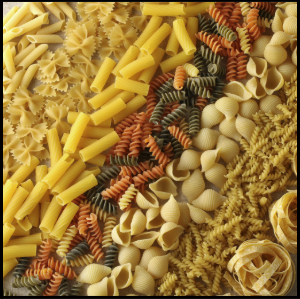
The answer is, surprisingly, surface area. A long, smooth noodle like spaghetti is terrible at holding a thick, chunky meat sauce, as the sauce just slides off and pools are at the bottom of the bowl. Furthermore, a shape like rigatoni which is a wide tube with ridges on the outside is quite perfect for this task. This is because the ridges create extra surface area for a thick sauce to cling to, while the hollow centre acts as a tunnel, trapping pieces of meat and vegetables inside.
When you change the shape of the food, you change the ratio of sauce to starch in every bite. The geometry literally dictates the flavour of the dish. Additionally, Shape can also create texture. And neurologically speaking, our brains confuse texture with flavour.
Moreover, think about a chocolate bar. If you take the exact same recipe of chocolate and mould it into a thick, chunky block, it will taste totally different than if you shave it into delicate, thin flakes. Likewise, the thin flakes melt on your tongue instantly, coating your taste buds and delivering a massive, sudden hit of sweetness and cocoa. The thick block melts slowly, giving you a gradual, muted flavour release.
The ingredients never change. The only thing that changed was the physical shape of the food. Which altered how fast it broke down in your mouth.
While chefs care about shape for flavour, food engineers care about shape for survival. In the modern global food system, if a product can’t survive being loaded onto a truck, stacked in a warehouse, and bounced down a highway, it’s useless.
This is where the geometry of food gets incredibly high-tech.
Take the standard potato chip. A bag of regular chips is a logistical nightmare. The chips are randomly shaped, meaning they don’t pack efficiently. Thus, to keep them from being crushed into dust during shipping, the manufacturer has to pump the bag full of nitrogen gas to act as a cushion. This means we are essentially paying to ship air, quite ironic for one of the most plentiful substances on Earth.
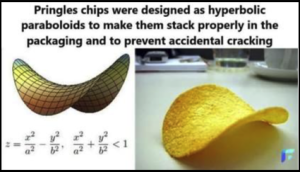
Lastly, look at a Pringle isn’t a random slice of a potato, it is carefully shaped as a hyperbolic paraboloid. This shape is a masterpiece of food logistics for two reasons:
The first reason is perfect stacking. This is because every single chip is the exact same curve, they rest perfectly inside each other. There is zero wasted space. You can fit vastly more chips into a single cylindrical tube than you can in a standard bag.
Secondly, structural strength. The saddle-like curve of the chip is incredibly strong. It resists the downward pressure of the chips stacked on top of it, meaning they rarely break in transit, even without a cushion of air.
Perhaps by changing the physical shape of the food, they created a product that is cheaper to ship, takes up less space on a grocery store shelf, and early brakes.
In conclusion, the next time you eat, pay attention to the shape. Whether it’s pasta tube trapping sauce or a perfectly stacked potato chip surviving a cross-country road trip, the geometry of your food is doing a lot of heavy lifting.
References:
Alarcón, C. (2025, March 5). Can the shape of chocolate really influence its taste? Tasting Table. https://www.tastingtable.com/1800509/chocolate-shape-affects-taste/
Jahncke, K. (2024, June 28). Texture of food: How taste and texture influence each other. Paradise Fruits. https://www.paradisefruits.com/texture-of-food-how-taste-and-texture-influence-each-other/
Kaya, A. (2026, April). The geometry behind Pringles. Abakcus. https://abakcus.com/articles/geometry-behind-pringles
Myers, D. (2018, November 5). Pringles are hyperbolic paraboloids. The Daily Meal. https://www.thedailymeal.com/eat/pringles-are-hyperbolic-paraboloids/
Scinto, M. (2025, December 16). Here’s an aspect of chocolate you would never think affects the flavor, but it does. The Takeout. https://www.thetakeout.com/2048482/how-chocolate-shape-affects-flavor/