Written By: Mannat Malhan
Edited By: Prakhar Sood
Designed By: Andria Sahar
Published By: Ayman Anas Khan
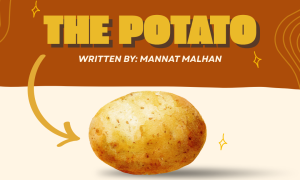
The Potato
What comes to mind when you hear the word potato? Fries? Mashed potatoes? Maybe a baked potato loaded with cheese? Potatoes are one of the most common foods in many diets, but their history goes back thousands of years and spans several continents. The crop was first domesticated in South America and was later introduced to other parts of the world. Today, potatoes are grown in more than 150 countries and are a crucial source of food, nutrition, and income for farming communities.
Potatoes were first grown in the Andes thousands of years ago. Indigenous communities cultivated hundreds of potato varieties that could survive the region’s different climates and growing conditions. This history created an enormous amount of genetic diversity. According to the Food and Agriculture Organization of the United Nations (FAO), there are more than 5,000 potato varieties worldwide. They differ in characteristics such as colour, size, shape, growing conditions, and resistance to pests and diseases. Potatoes eventually spread beyond South America and became an important crop in Europe, Asia, and Africa. They are now grown in a wide range of environments, from highlands to farming regions. One reason for their widespread cultivation is their adaptability. Potatoes can be grown under different temperatures, soil conditions, and farming systems, allowing farmers around the world to produce them.
Let’s take a look inside a potato. It’s best known for its carbohydrate content, which provides the body with energy. It also contains several vitamins and minerals, including vitamin C, potassium, vitamin B6, folate, phosphorus, and magnesium. Potatoes with their skin can also provide fibre. The nutritional value of a potato depends on the variety and how it’s prepared. A baked potato, boiled potato, and deep-fried potato can have very different profiles even though they begin with the same crop. Regardless, the right preparation of any potato can contribute useful nutrients to a diet
Potatoes are also valuable because of how they grow. Compared with some major grain crops, potatoes can produce a large amount of food from a relatively small area of land. They also grow in environments where there may be difficulty in producing reliable yields. This makes them useful in areas where farmland is limited or environmental conditions make agriculture more difficult. They provide farmers with both food and income because a portion can be kept for consumption while the rest can be sold in local markets. These connections make potatoes relevant to both household and rural economies.
Food security means that people have consistent access to enough safe and nutritious food. Agriculture has to maintain that access while dealing with challenges like climate change, water scarcity, soil degradation, and pests. As mentioned, potatoes contribute to food security because they produce substantial amounts of food in a variety of growing conditions. Their nutritional content allows them to contribute carbs, vitamins, minerals, and fibre to people’s diets. Their genetic diversity is another important factor. Thousands of potato varieties have developed through generations of cultivation and selection, and preserving this diversity gives farmers and researchers more genetic material to work with when developing crops that can handle changing conditions. The FAO has identified potatoes as an important crop for food security, agriculture, and rural livelihoods. Their ability to provide food while supporting farmers makes them relevant as food systems face increasing pressures.
It’s easy to overlook potatoes because they’re so familiar. They are inexpensive, widely available, and found in everything from cafeterias to restaurants around the world. Their history, however, is anything but simple. Indigenous communities developed and preserved thousands of varieties, and that genetic diversity has allowed potatoes to become one of the world’s most widely grown food crops. A potato might end up as fries on a lunch tray, but the crop behind those fries is connected to thousands of years of agriculture, global food systems, and the future of food security.
References
Potatoes may have given Indigenous Andeans a digestive superpower. (2026). ScienceDaily.
The potato’s travel through ages and continents. (2024). In Newsroom. FAO.
Ortiz, O., & Mares, V. (2017). The Historical, Social, and Economic Importance of the Potato Crop. Compendium of Plant Genomes, 1–10.
Robertson, T., Alzaabi, A., Robertson, M., & Fielding, B. (2018). Starchy Carbohydrates in a Healthy Diet: The Role of the Humble Potato. Nutrients, 10(11), 1764.
Devaux, A., Goffart, J.-P., Kromann, P., Andrade-Piedra, J., Polar, V., & Hareau, G. (2021). The Potato of the Future: Opportunities and Challenges in Sustainable Agri-food Systems. Potato Research, 64(4).
Devaux, A., Goffart, J.-P., Petsakos, A., Kromann, P., Gatto, M., Okello, J., Suarez, V., & Hareau, G. (2020). Global food security, contributions from sustainable potato agri-food systems. In H. Campos & O. Ortiz (Eds.), The potato crop: Its agricultural, nutritional and social contribution to humankind (pp. 3–35). Springer.