Every single day, households around the world throw away enough edible food to equal more than 1 billion meals. Not 1 billion meals a year. Not 1 billion meals a month. Every single day! In 2022, that added up to 1.05 billion tonnes of food wasted at the household, food-service, and retail level. When food lost earlier in the journey, for example on farms, during storage, transportation, and processing, researchers estimate that up to 40% of the world’s food may never make it to someone’s plate.
For years, researchers have estimated that about one-third of the world’s food is lost or wasted. More recent research suggests the problem could actually be even larger. The World Resources Institute (WRI) says estimates range from 30% to 40% of all food produced, depending on what stages of the food system are measured.
So where does all this food go, and why are we wasting so much of it?
The Scale of the Problem
The numbers are difficult to imagine. According to the United Nations Environment Programme (UNEP), the world wasted 1.05 billion tonnes of food in 2022 at the retail, food service, and household level. That was almost one-fifth of all food available to consumers. Households were responsible for 60% of this waste, while food services accounted for 28% and retail for 12%.
But that is only part of the story. Food can be lost long before it ever reaches a grocery store. The Food and Agriculture Organization of the United Nations (FAO) estimates that 13.3% of food was lost globally in 2023 between the post-harvest stage and retail. That includes food lost during harvesting, storage, transportation processing, and distribution. In some places, a lack of proper refrigeration, storage facilities, roads, or reliable transportation can make it much harder to get food from farms to consumers before it spoils.
This shows why food waste is bigger than simply asking, “Why do people throw away food?” To understand the problem, we have to follow food through the entire system — from the farm, to transportation and processing, to the grocery store, restaurant, and finally our own kitchens.
It Starts on the Farm
One of the biggest misconceptions about food waste is that food is only wasted after it reaches consumers. In reality, some food never leaves the farm at all.
In developed countries, an estimated 20 percent of food is wasted on the farm or from improper or inadequate  drying, storage, packaging and transportation.
Losses after harvest are most pronounced in less-developed countries, where an estimated 30 percent of food is wasted.
Farmers can lose crops because of extreme weather, pests, diseases, poor storage, or a lack of workers to harvest them. However, perfectly edible food is left behind for a much simpler reason: it does not look the way buyers expect it to.
A crooked carrot, a small apple, or a banana with an unusual shape can be rejected because it does not meet a retailer’s appearance standards. National Geographic has highlighted how bananas that are perfectly safe to eat can be left behind because they are too short, too thin, too curved, or have small marks on their skin. UC Davis researchers also point to size, shape, colour, and maturity as factors that can cause perfectly edible produce to be rejected.
This raises an interesting question: When did food have to look perfect to be considered good enough to eat?
The answer is complicated because farmers and retailers are responding to what consumers expect. If shoppers consistently choose the most uniform-looking fruits and vegetables, stores have a reason to stock them. That means food waste is not just a problem created by one person or one part of the industry. It is connected to the choices and expectations of the entire food system.
From the Store to Our Home
Even after food makes it through the farm and transportation, it can still end up being wasted at stores, restaurants, and homes. Grocery stores may order more food than they can sell, while restaurants can have ingredients or prepared meals left over at the end of the day. At home, it can be as simple as forgetting about leftovers in the fridge or buying more than we can finish.
In fact, households were responsible for 60% of food waste in 2022, making them the largest source of food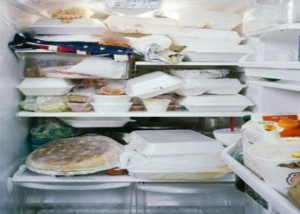 waste at the consumer level. This doesn’t mean consumers are entirely to blame. The way food is packaged, advertised, sold, and labelled can all influence what we buy and eventually throw away. Food waste is a problem across the entire food system.
The Hidden Cost of Wasted Food
When food is thrown away, we are not just wasting the food itself. We are also wasting everything that went into producing it — water, land, energy, labour, packaging, and transportation.
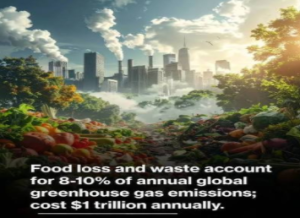 Food loss and waste are responsible for around 8–10% of global greenhouse gas emissions. When wasted food ends up in landfills, it can also produce methane as it breaks down, adding even more to its environmental impact.
This makes food waste much bigger than an issue of unfinished meals. It is connected to climate change,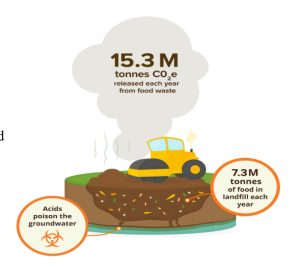 resource use, money, and the way our entire food system operates.
What About Canada?
Canada is not separate from this problem. The Government of Canada estimates that around 20% of food produced in Canada, or about 11 million tonnes each year, becomes avoidable food loss or waste.
That means there are opportunities to make a difference right here at home. Planning meals, checking the fridge before shopping, storing food properly, freezing food before it goes bad, and finding ways to use leftovers can all help reduce the amount we throw away.
Changing the Way We Think About Food
Food waste may seem like a small problem when we look at one forgotten container in the fridge or one imperfect piece of fruit at the grocery store, but when those choices happen millions of times every day, they become a global problem.
Every meal we waste represents more than food. It represents the water that grew it, the land that produced it, the people who worked for it, and the energy that carried it to us. And when more than one billion meals are wasted every single day, we have to ask ourselves: how much are we willing to waste before we decide that enough is enough?
Reducing food waste won’t happen overnight, but every better decision moves us toward a food system where more food reaches plates instead of landfills; and for a problem this global, that’s a journey worth changing.
Sources:
- Environment, U. (2024, March 27). Food waste index report 2024. UNEP. https://www.unep.org/resources/publication/food-waste-index-report-2024
- Goodwin, L., & Lipinski, B. (2024, November 25). How much food does the world really waste? what we know – and what we don’t. World Resources Institute. https://www.wri.org/insights/how-much-food-does-the-world-waste
- Food and Agriculture Organization of the United Nations . (2026, June 9). 12.3.1 Global Food Losses: SDG indicators data portal: Food and agriculture organization of the united nations. SDGIndicators. https://www.fao.org/sustainable-development-goals-data-portal/data/indicators/1231-global-food-losses/en
- Canada, E. and C. C. (2019, June 28). Taking stock: Reducing food loss and waste in Canada. Canada.ca. https://www.canada.ca/en/environment-climate-change/services/managing-reducing-waste/food-loss-waste/taking-stock.html
- Quinton , A. (2025, January 7). Why is one-third of our food wasted worldwide?. UC Davis. https://www.ucdavis.edu/food/news/why-is-one-third-of-food-wasted-worldwide