Written by: Mannat Malhan
Edited by: Ish Modi
Designed by: Danujan Krishnakumar
A single teaspoon of healthy compost contains more microorganisms than the number of people on Earth. Insane, right? These tiny organisms are nature’s ultimate recyclers, working alongside bacteria, fungi, and larger creatures to consume organic matter. 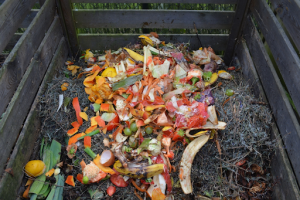 This is what composting is. But, do you know what’s happening inside the heaps of scrap?
Composting is the process of recycling organic matter, such as food waste, into a substance that can provide nutrients to soil and plants. This product, when organic matter breaks down, is what becomes compost. Microorganisms act like the primary decomposers, followed by fungi and other larger organisms, to break down materials. In the first days, bacteria will feed on simple compounds, such as sugars and amino acids, which causes temperatures to rise in the waste pile. As the temperature rises, usually around 45 degrees Celsius, heat-loving thermophiles will begin to break down proteins, fats, and cellulose. This phase kills off any harmful pathogens as well. As food supply decreases and temperature drops, fungi join to decompose the waste pile. Good items to compost include:
| Good items to Compost | Bad items to Compost |
| Fruit and vegetable scraps | Meat, dairy, and oily foods |
| Coffee grounds and filters | Pet waste |
| Eggshells | Diseased plants |
| Leaves, grass, and small branches | Plastics or treated wood |
Knowing what belongs in your compost helps keep it healthy and odour-free. The compost “recipe” includes greens and browns. The greens (nitrogen) include food scraps and grass clippings. The browns (carbon) include dry leaves, cardboard, and paper. Microorganisms work best when these two are mixed. Too many greens can make a waste pile smelly, and too many browns can slow down the composting  process.
Now that we have a good grasp of how composting works, let’s explore the awesome benefits it brings! What great things can come from turning kitchen scraps and yard waste into rich compost? Organic matter in landfills decomposes anaerobically (without oxygen), producing the greenhouse gas, methane, which is 28 times more potent than carbon dioxide. Composting helps reduce methane emissions by diverting waste from landfills and making practical use of it to help the environment. It also returns nutrients to the soil and helps store carbon in the ground, reducing the need for artificial fertilizers and lowering waste disposal costs for communities. Because of these benefits, organizations like the Food and Agriculture Organization of the United Nations encourage composting as a practical way to cut food waste and improve soil health around the world.
So, there’s that!  Composting turns everyday kitchen scraps and yard waste into rich, living soil. It reduces greenhouse gases, supports plant growth, and helps protect the environment, all through a natural process powered by tiny organisms. With just a little effort, anyone can help close the loop of nature’s recycling system and make a real difference for the planet!
References
EPA. (2018, October 16). Composting at home. https://www.epa.gov/recycle/composting-home.
Hu, S. (2020, July 20). Composting 101. NRDC. https://www.nrdc.org/stories/composting-101.
THE SCIENCE OF COMPOSTING. (n.d.). https://cwmi.css.cornell.edu/chapter1.pdf.
UN Environment Programme. (2021, July 27). How composting can reduce our impact on the planet. https://www.unep.org/news-and-stories/story/how-composting-can-reduce-our-impact-planet.
Silver, W., & Abbott-Lum, F. (2022, January 10). Yale Experts Explain Compost | Yale Sustainability. https://sustainability.yale.edu/explainers/yale-experts-explain-compost.