
Written by: Aryan Bharucha
Edited by: Ocean Croft
Designed by: Danujan Krishnakumar
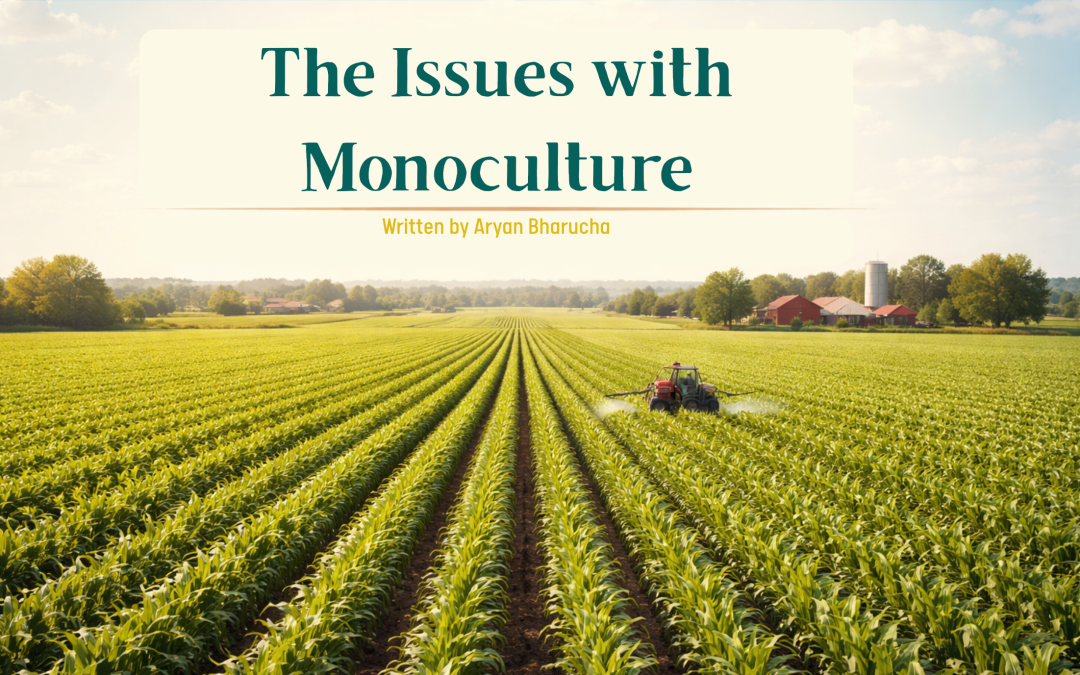
Farmers are the cornerstone of our world. They grow crops and provide food to thousands around the globe, and they ensure efficiency by growing multiple crops at once. Monoculture is the practice of growing only one type of crop in a field or large area, usually year after year. This practice reduces biodiversity, uses more chemicals, and causes the soil to erode. Let’s take a deep dive into monoculture and the issues present with this practice.
 Loss of Soil Nutrients
Growing different crops requires different nutrients to grow efficiently. Planting the same crops over and over again would mean the depletion of those specific nutrients. This forces farmers to use chemical fertilizers in order for their crops to grow, which pollutes the nearby water.
 Disease Problems
The issue with growing a singular crop in an entire field was that if a disease was present, all crops would be affected by this.
There was no barrier to stop the disease, which would ultimately result in all crops becoming affected.
Reduced Biodiversity
Plant diversity becomes limited when practicing monoculture as it reduces plant variety, reduces animal diversity, and harms pollinators. This makes ecosystems weaker and less resilient to diseases
Conclusion
Although monoculture helps farmers in the short term, it causes serious environmental problems long term. It causes the loss of soil nutrients, allows for disease to easily spread, and reduces biodiversity. It’s important to recognize these problems, and how they can affect the Earth long term.
Work Cited
Resources
- https://projects.research-and-innovation.ec.europa.eu/en/horizon-magazine/rise-and-fall-monoculture-farming
- https://www.earthday.org/one-crop-to-rule-them-all-the-hidden-dangers-of-monoculture-farming/
Image Credit