Written by Georgina Baronette
Edited by Mannat Malhan
Designed by Yaashi Mulchandani
An exploration into the purpose of seed vaults within the context of contemporary climate change threats
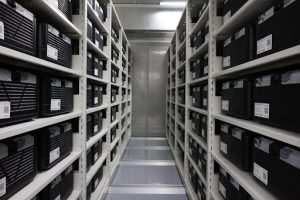
They can be embedded in a mountain or buried below the Earth’s surface. They can have infrastructure against floods, droughts, radiation, nuclear attacks, and even direct crashes with an airplane (Leach, 2026). Their security is often tight, including ID cards, vaults, and even identical storage systems to prevent robbery. All for…seeds.
Seed vaults, as they are called, are the buildings and institutions that safeguard a multitude of seeds for future agricultural needs in the case of disaster. While dramatics are often associated with seed vaults in general because of their security and appearance (guilty!), the reality is that seed vaults do, in fact, have a definition that recognizes both the apocalyptic and the hopeful. Following this, today’s post aims to explore the reality of seed vaults. That is, their purpose, impact, processes, and why they might be important now.
Background
 The origin story of seed vaults can be traced back to 6,750 BCE in and around the regions of Iraq, where archaeologists have discovered remnants of intentional seed deposits. The storage system was made up of baskets packed with ash and seeds, then placed in the ground or in the elevated spaces of a hut (Ronca, n.d.). At this time, it is most likely that the seeds were for basic agriculture. Now, however, seed vaults are home to a variety of seeds from all species of plants and for various purposes.
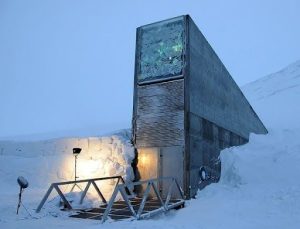
For example, the notable Svalbard Seed Vault in Norway houses a worldwide selection of edible and agricultural seeds (Svalbard Global Seed Vault, 2026) while the Millennium Seed Vault in the U.K. gears towards the protection of wild seed species (Leach, 2026). Many more may store only potato seeds, only Indigenous crops, or perhaps only certain tree varieties. All play a crucial role in fortifying Earth’s biodiversity, but how do they do it?
Seed Vaults In Action
Up next, the processes of seed storage. For starters, some seed vaults acquire their collections through donations from other agricultural and environmental organizations, where the act of storing means protecting.
Svalbard, for instance, “houses 1,378,238 seed samples from almost every country globally, with room for millions more”, writes Julia Daye in Popular Science (Daye, 2025).
When a seed arrives at the vault, it must be stored in a particular manner, and this might change depending on the type. Most seeds need to be clean, dry, air-locked, and cold (think around -20C) for proper long-term dormancy. However, for other seeds, a method of cryopreservation may work better. This is a process that involves submerging and storing the seed in liquid nitrogen, which is roughly -196 °C. In other cases, like the modern-day banana, which doesn’t have seeds, scientists must freeze the entire fruit in a process called “in-vitro storage” (Ronca, n.d.). So, as research and development surrounding seed vaults advances, the real question is how they might be important in the context of an increasingly volatile climate.
Current Climate Contexts
A combination of industrial agricultural practices and global warming effects contributes to a risk of food insecurity, which leads to the need for seed vaults. For one, contemporary industrial agriculture is characterized by excessive amounts of pesticides and the practices of monocropping (planting only one type of crop), which each increase the risk of either extremely resistant pests or disease vulnerability (“Pros and Cons of Monocropping in Modern Agriculture,” 2025). Climate change, however, is the main concern for seed vaults. With rapidly changing climates that lead to droughts, floods, and unpredictable weather, plants cannot rely on natural evolution–a millennial process–to adapt to these changes.
“Under climate change, that means rougher climates, higher temperatures, longer droughts, more flooding, new pests and diseases,” says Stefan Schmitz, Executive Director, Crop Trust (“Seed Vault Becomes More Important,” 2023).
 Seed vaults’ importance within these critical contexts can be shown through examples. In 2004, when a tsunami hit rice agriculture in Southeast Asia, seed vaults helped replenish the supply (Ronca, n.d.). In 2020, when Australia was battling such expansive wildfires that the summer was titled the Black Summer, seed vaults again stepped in to help rejuvenate the lost biodiversity (Leach, 2026).
Looking further back, to what seed vaults could have done, it is noted that the horrors of the Irish Potato Famine of the 1840s and the U.S. corn crisis in the 1970s could have been alleviated with the support of seed vault inventories. In short, seed vaults are a critical measure in ensuring a nation’s and the world’s biodiversity and food security through disaster and crisis.
Conclusion
In summary, this post covers the purpose, origin, and storage methods of seed vaults. This was then followed by the core context of why they are important now, when our planet is dealing with the increasing effects of climate change in all of its forms. So, from clay pots to radiation-proof facilities, from the purpose of storage to backups for the world’s plants, seed vaults have come a long way, and so have the conditions we are facing. As Sanghyun Kim noted in an article posted in the Ecological Society of America, there is a Greek saying that encapsulates the seed vaults’ purpose. It says, “society grows great when old men plant trees whose shade they know they shall never sit in” (Kim et al., 2023). Considering this forward-thinking, while they may not be the only measure to safeguard Earth’s biodiversity (and we certainly shouldn’t limit ourselves to them), seed vaults are an important factor. A key if you will, to securing a world where ecosystems, agriculture, and food supply are rich, diverse, and healthy: planted seeds for the future, life, and all of its possibilities.
References
Daye, J. (2025). The Seed Vaults That Could Save Humanity. Popular Science. https://www.popsci.com/science/what-are-seedbanks/
Global Seed Vault becomes more important than ever as climate change threatens crops. (2023). PBS News. https://www.pbs.org/newshour/show/global-seed-vault-becomes-more-important-than-ever-as-climate-change-threatens-crops
Kim, S., Kim, M., Anni, N. S., & Bae, K. (2023). Preserving the future: The importance of seed vaults in conserving wild plants – Early Career Ecology Section. ESA. https://esa.org/earlycareer/2023/03/28/preserving-the-future-the-importance-of-seed-vaults-in-conserving-wild-plants/
Leach, N. (2026). The world’s biggest “doomsday vault” has now been opened. Here’s what’s inside. BBC Science Focus Magazine. https://www.sciencefocus.com/planet-earth/worlds-largest-doomsday-vault-seeds
Pros and Cons of Monocropping in Modern Agriculture. (2025). Agriculture Institute. https://agriculture.institute/basic-horticulture/pros-and-cons-of-monocropping-in-agriculture/#increased-vulnerability-to-pests-and-diseases
Ronca, D. (n.d.). How Seed Banks Work. How Stuff Works. https://science.howstuffworks.com/environmental/green-science/seed-bank1.htm
Svalbard Global Seed Vault. (2026). Britannica. https://www.britannica.com/topic/Svalbard-Global-Seed-Vault