
Behind the Scenes at Seeds of Diversity - first of a series

You know that Seeds of Diversity saves, collects, and distributes thousands of rare seeds every year, but what really happens behind the scenes? The truth is that it looks a lot like what every seed saver does at home, so you can do it too. Over the next few months we'll take you through the full life cycle of a seed in Seeds of Diversity's collection.
First : The Research
We have about 2500 different kinds of seeds in our Seed Library collection, our helpful home seed savers offer over 3300 varieties through the Seed Exchange, and according to our Seed Finder there are over 10000 varieties of vegetables available from Canadian seed companies. How do we decide which varieties to collect, which seeds to grow out, and when?
It's a difficult choice, but we have a few simple criteria
- If a variety is not available from seed companies, we want to make sure that Canadian gardeners can still get seeds from seed savers.
- If a variety is grown and offered by our seed savers, then they must have liked it, and it must be able to grow in their region of Canada.
- If seeds of one of those varieties are in short supply, or aging in our collection, we have to find a seed saver to rejuvenate it and multiply more seeds.
That's how we came across The Prince bean. We'll tell you the whole story of how we found, researched, rejuvenated, and distributed this bean over several articles, but the most important point is that we work through the same process for hundreds of varieties every year. All our beans, lettuces, wheats, peas, and everything else, get the same treatment and the same consideration.
The Prince bean has a beautiful seed, and we noticed that we had a large packet of it in our collection from 2012. Many of our collected seeds are stored in a large freezer, well-dried with silica gel, to keep them viable for many years. In our regular overview of the thousands of seeds in storage, The Prince eventually rose to our attention because of the age of the seeds and the fact that it did not appear in any Canadian seed catalogs.
The Seed Finder, The Seed Exchange, The Seed Collection Database
Every year we update our Seed Finder, an index of all the vegetables sold by all the seed companies in Canada (that we know of). We present it as a useful tool for gardeners to locate sources of seeds, but its real purpose is to help us prioritize the varieties in our seed collection. When The Prince bean came up as "available from 0 companies", that triggered us to look at it more closely.
The next step was to see if it's offered by any seed savers in the Seed Exchange. It wasn't.
We checked our Seed Collection Database, which shows the full history of the variety. Here's what it said.
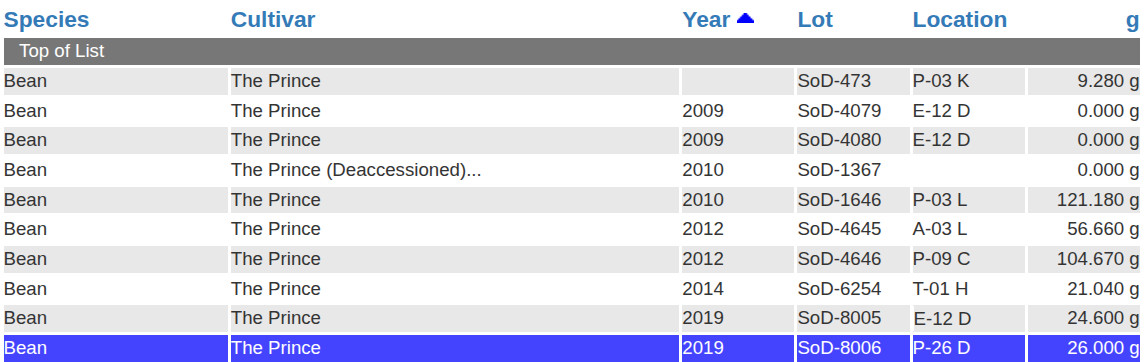
We could see that there were several seed lots from 2009 through 2019, and some of them had been used up. For example, the 2010 lot was used to grow the 2019 seeds, which were stored in two separate places: one frozen (in a freezer box labeled P-26) and one at room temperature (in a box labeled E-12) with a total weight of 50.6 grams.
Our Seed Library database knows that beans can range from 0.25 to 2.0 grams, so 50.6 grams is not a lot. With a little more investigation we found a record saying that 100 seeds of The Prince bean normally weigh 47.3 grams. We'd prefer to have at least 400 seeds of our rarest beans, and preferably 600, so we knew we had to get more somehow.
Searching the Internet
Although our Seed Finder indexes all the Canadian seed catalogs we can find, we can always learn a lot more from a Google search. Sometimes, we learn too much, and it often gets confusing.
There is a The Prince bean grown in the U.K., and some mention of it in New Zealand, but we were not able to find any information about it in Canada or the U.S.
A few companies in the U.K. sell The Prince bean, including Mr. Fothergill's Seeds, but it does not seem to be marketed outside of the U.K.
The Koanga Institute (New Zealand's sister organization to Seeds of Diversity) mentions a bean called "Bean Dwarf Kaiapoi Pink Seeded Bush (AKA The Prince, Canadian Wonder)". That seemed hopeful. Was The Prince just another name for the commonly available Canadian Wonder bean? A quick check of their web site showed an image of red Canadian Wonder bean seeds, not the purple-brown striped beans we had. It's unfortunately very common for seeds to pick up nicknames, alternate names, mistaken names. We usually can't tell why, but you have to be careful with seed names.
In the end, we determined that our bean is most likely the U.K. variety (not related to Canadian Wonder) and it doesn't seem to be available outside of that region. Sometimes, we would try to import a seed from another country, but beans are easy to grow so it made sense to re-grow our seeds rather than try to purchase them from overseas. Besides, even if we could somehow import them, they were only available in packets of 15-20 beans, so we'd have to buy 35 packets to get the amount we'd like to preserve. Better to regrow them.
Searching our Seed Exchange Records
Part of our research includes looking up our own records, of course. We first obtained these seeds from our own seed saver friends in the Seed Exchange. Looking back at our 2009 Seed Exchange Directory we find this:
IL KE D BEAN/BUSH | THE PRINCE
70 dtm Bountiful Gardens
Snap bean. Plant grows to 18+ inches tall; a good producer of beans that are maroon with tan markings. Pods of 5" long with 4 - 6 beans per pod. Really good snap bean.
Some of our long-time members might remember Don Kellums, who grew a large collection of beans. We got our first lot of The Prince from him in 2009, and his description matches our bean. He gave his original source as Bountiful Gardens, which was a California seed company that is no longer in business, but back then they had a large assortment of rare heritage seeds.
A little later in 2012 we find this in our Seed Exchange:
BC BE S BEAN/BUSH | THE PRINCE
55 dtm IL KE D
Long green pods are sweet tasting for fresh eating. British heirloom. Seeds are beautiful with red and white markings.
This seed saver (who's still listed in our Seed Exchange today!) got seeds from Don, who went by the code IL KE D. They knew it was a British heirloom, which helps confirm our research above. The note about red and white markings seems to not match the image above, but it's common for freshly-harvested bean seeds to have lighter colouring, which deepens as they dry and age.
And another entry from 2014 tells more:
IL CR R BEAN/BUSH | THE PRINCE
60 snap / 90 dry Ozark Seed Bank 11
Blossom white. Plants are 14" tall, grow upright without runners. Pods are 7-8 x 5/16" nearly stringless but coarse in texture. Seeds are a mottled pattern. Predominantly dark red with light cream tan when the seed is new. Prince is the result of a cross of Superlative and Perfection. Introduced by Sutton and Sons in the UK in 1927 and the US in 1929.
Russ Crow, a bean collector's superhero, provided this information over a decade ago. It further confirms the origin of The Prince in the U.K. and even gives some leads to understand the parentage of the bean.
Good Enough for Now
All we really needed to know was: The Prince bean is well-liked, and well suited to growing in Canada, but cannot be easily obtained here.
That makes it a great candidate for a seed saver to multiply, to rejuvenate the stock in our collection and also to make the beans available to Canadian gardeners.
We'll continue the story in future months by showing how we found a seed saver to multiply our small lot of The Prince beans, and what became of them.
Meanwhile, do you want to be a seed sleuth?
Now you know as much as we do about the origin of this bean. There are a few leads to follow: Sutton and Sons, Superlative bean, Perfection bean, Bountiful Gardens. If you go down the internet rabbit hole of The Prince bean and find out something interesting, let us know!
Not yet a member?
An annual membership to Seeds of Diversity gives you access to our seed exchange, seed grow-out programs, and our online news.


We depend on donations to do our work.

Thank you for your support!
Stay in Touch!


